
Recently, the results of the 14th International Conference on Learning Representations (ICLR 2026) have been announced.A research paper titled Aligning Collaborative View Recovery and Tensorial Subspace Learning via Latent Representation for Incomplete Multi-View Clustering by the team led by Professor Wang Youqing from our college has been accepted.
Professor Wang Youqing (graduate supervisor) is the first author of the paper.Cao Yu, a 2024 master’s student from the School of Information Science and Technology, is the second author.Associate Professor Guo Jipeng (co-supervisor) serves as the corresponding author.Beijing University of Chemical Technology is the first affiliation and the only corresponding affiliation.
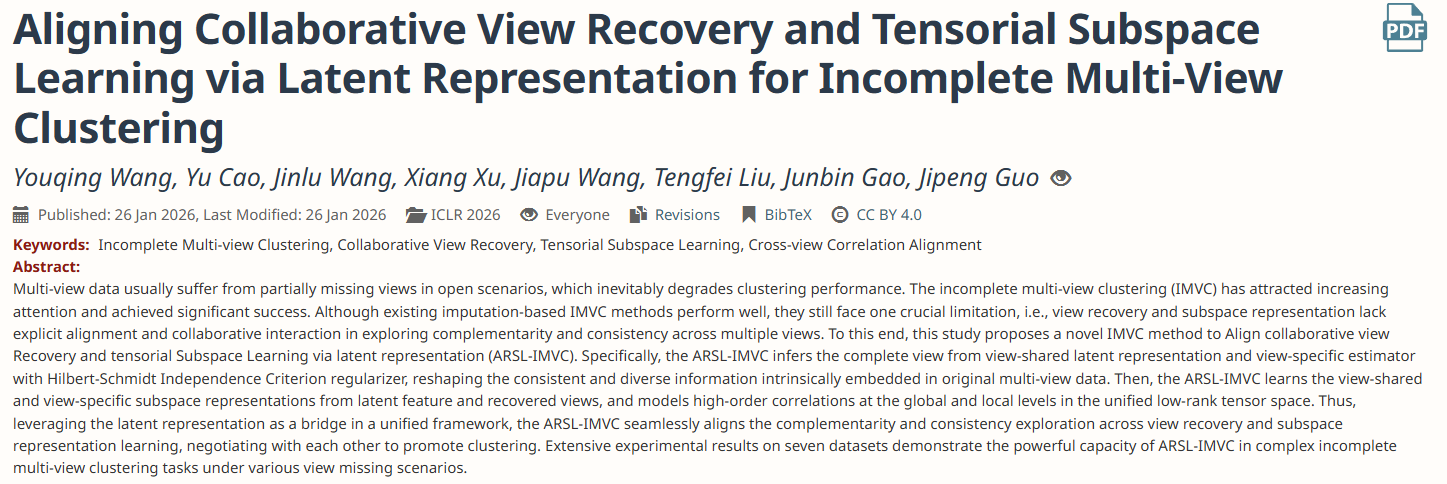
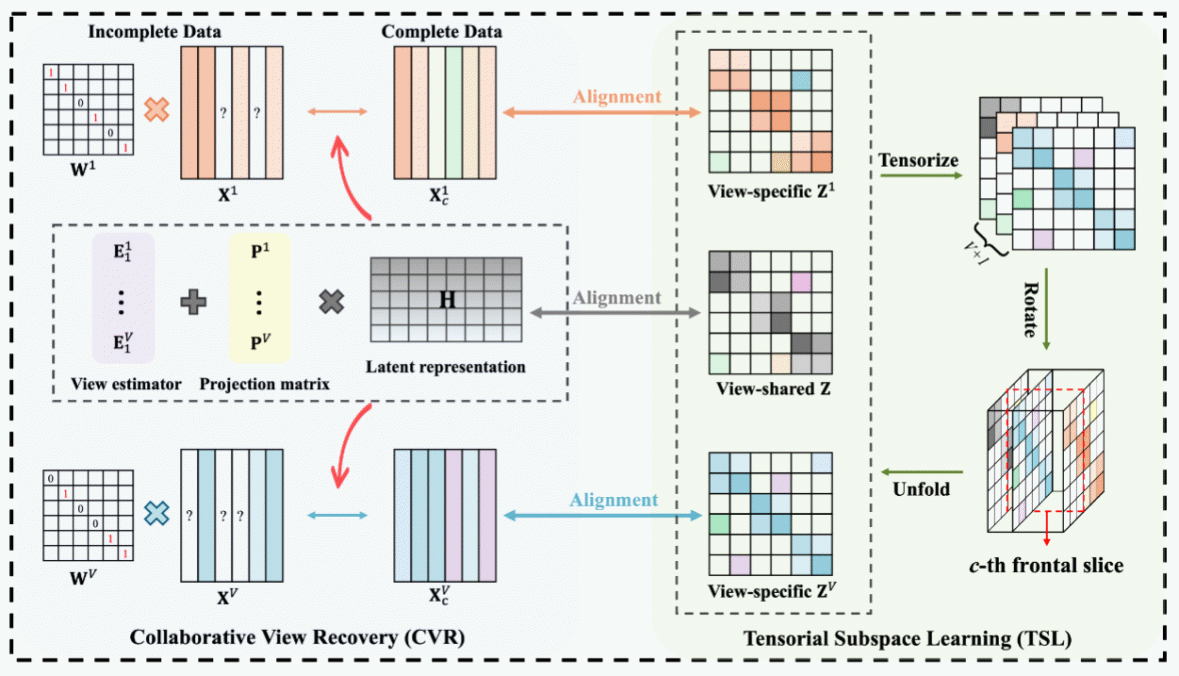
This study addresses the limitation that existing incomplete multi-view clustering methods lack explicit semantic alignment and collaborative interaction between view recovery and subspace representation when exploring cross-view complementarity and consistency. To this end, a novel tensor-based incomplete multi-view subspace clustering method, termed ARSL-IMVC, is proposed.
In most imputation-based incomplete multi-view clustering approaches, the recovered or completed views often suffer from limited structural fidelity and insufficient reconstruction of diversity and consistency. More importantly, missing view recovery and subspace representation learning lack explicit alignment and collaborative interaction in exploring complementarity and consistency.
ARSL-IMVC infers complete views by employing view-shared latent representations and view-specific estimators regularized by the Hilbert–Schmidt independence criterion, thereby reconstructing the inherent consistency and diversity information in the original multi-view data.
Furthermore, view-shared and view-specific subspace representations are learned from both latent features and recovered views, and global and local high-order correlations are modeled in a unified low-rank tensor space.
By taking latent representations as a bridge within a unified framework, ARSL-IMVC aligns the exploration of complementarity and consistency in both view recovery and subspace representation learning, and improves clustering performance through mutual collaboration.
ICLR (International Conference on Learning Representations) is one of the top international conferences in the field of artificial intelligence, co-founded in 2013 by Turing Award laureates Yann LeCun and Yoshua Bengio. The conference enjoys extensive and far-reaching international influence and ranks among the leading AI conferences in Google Scholar metrics.
Together with the International Conference on Machine Learning (ICML) and the Conference on Neural Information Processing Systems (NeurIPS), ICLR is widely recognized as one of the "Big Three Top Conferences in Machine Learning" — the most competitive, highest-level, and most influential conferences in artificial intelligence.
Distinct from other conferences, ICLR pioneered the Open Review mechanism, which has greatly promoted transparency and cutting-edge exploration in academic research.
ICLR 2026 received nearly 19,000 valid submissions, with an overall acceptance rate of approximately 28%. The conference will be held in Rio de Janeiro, Brazil, from April 23 to 27, 2026, showcasing the latest advances and breakthrough research in artificial intelligence and deep learning.
The acceptance of this paper marks another breakthrough made by our college in top-tier international conferences in the field of artificial intelligence.