
On June 25, the acceptance results of the ACM SIGSOFT International Symposium on Software Testing and Analysis (ISSTA 2026) were officially released. The research paper Signal Denoising based Kill Matrix Refinement for Mutation based Fault Localization by Professor Zheng Li’s research team has been successfully accepted. As one of the most influential top tier international conferences in software engineering categorized as CCF A, ISSTA 2026 received 888 valid submissions in total, among which 210 papers were accepted, yielding an overall acceptance rate of 23.6%.
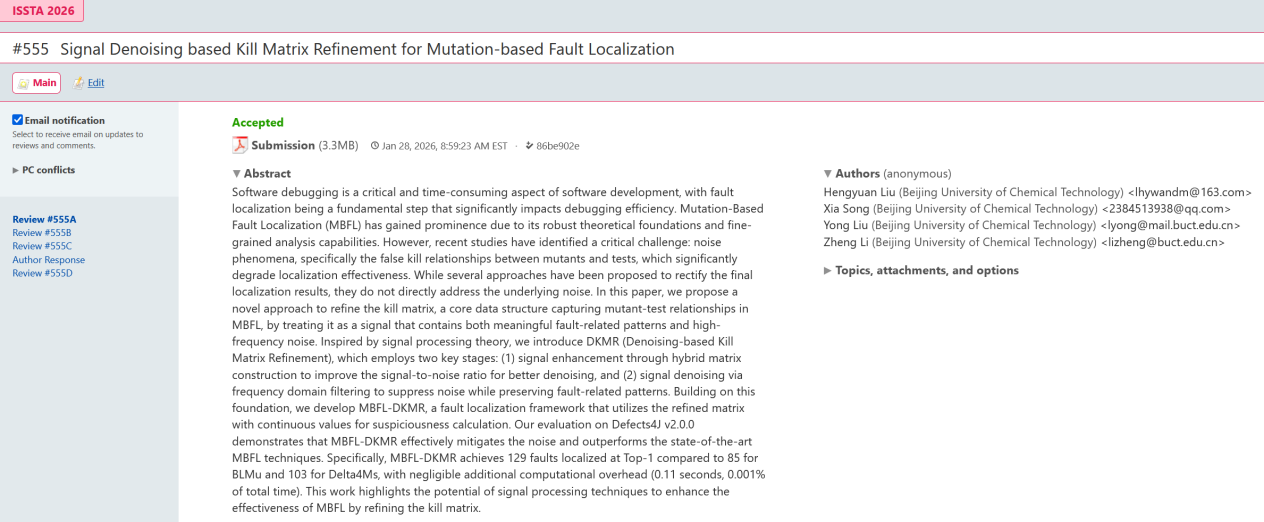
This paper targets the spurious kill relationships between mutants and test cases constructed during mutation analysis within Mutation Based Fault Localization (MBFL). Such spurious relationships degrade fault localization accuracy. To address core challenges including the difficulty of identifying spurious kill relationships and the high computational overhead incurred by conventional dynamic analysis based identification approaches, the authors innovatively adopt signal processing theory. They model the kill relationship matrix as a two dimensional signal and propose DKMR (Denoising based Kill Relationship Matrix Refinement), a two stage kill matrix refinement method built upon signal filtering. Composed of signal enhancement and signal denoising phases, DKMR mitigates the negative impact of spurious relationships inside the kill matrix on fault localization outputs.
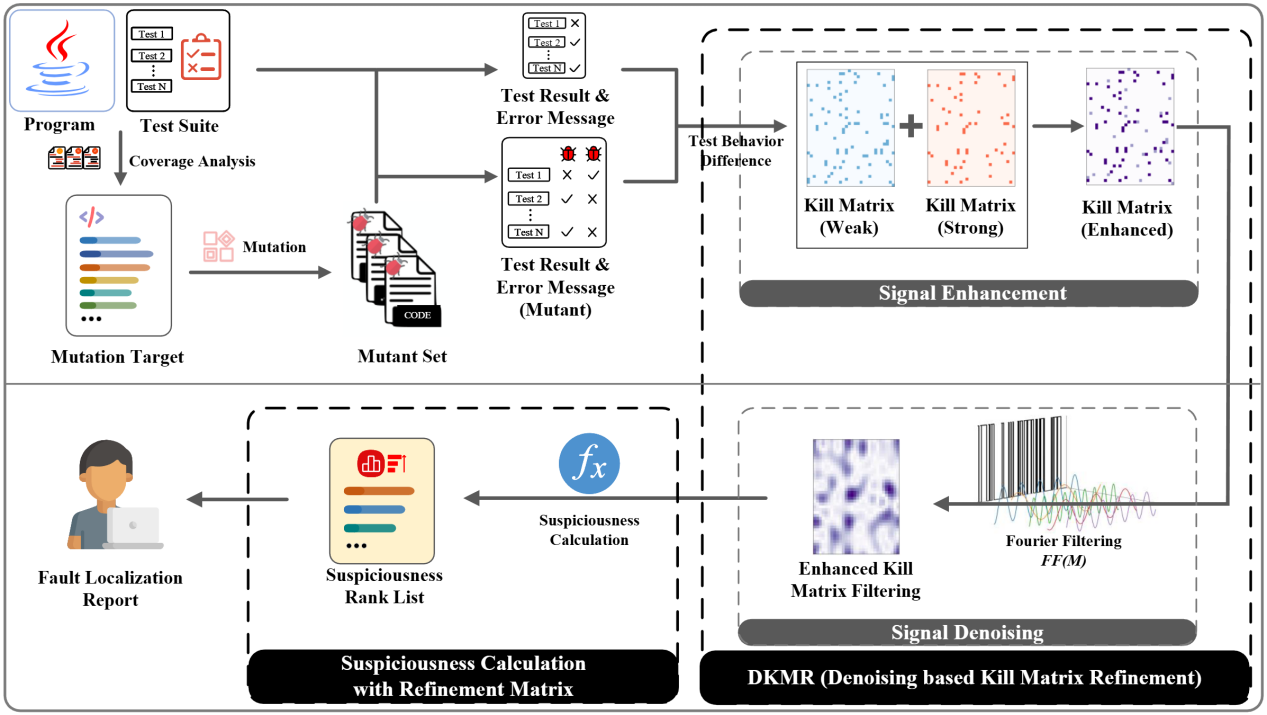
Figure of the DKMR Method Framework
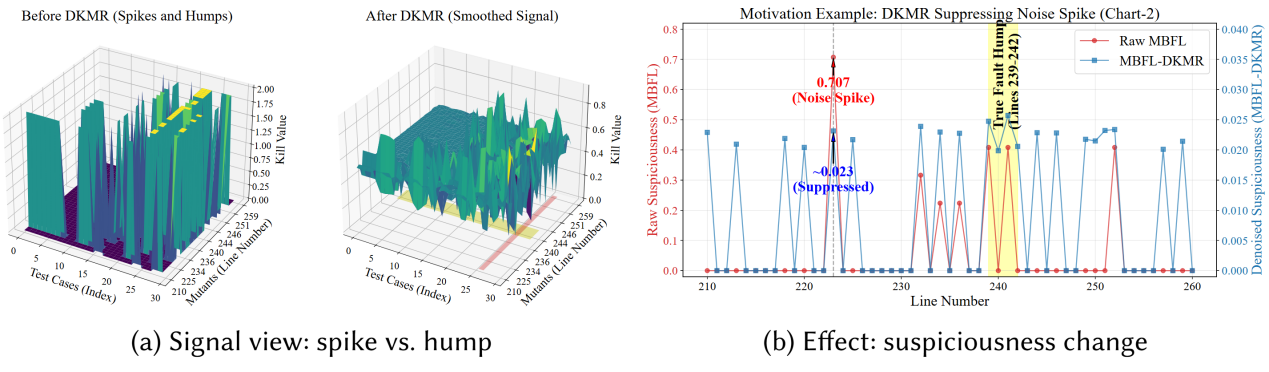
Example Illustrating the Kill Matrix Before and after DKMR Refinement as well as Corresponding Fault Localization Result Changes
The team conducted large scale empirical evaluations of DKMR on Defects4J, an authoritative benchmark dataset for software fault localization containing 17 projects and 835 real world faults. Experimental results demonstrate that DKMR can effectively suppress the adverse effects of spurious kill relationships and substantially boost fault localization accuracy while introducing only negligible overhead to MBFL.
The first author of this paper is Hengyuan Liu, a 2022 admitted PhD student from the College of Information Science and Technology, supervised jointly by Professor Zheng Li and Professor Yong Liu. Beijing University of Chemical Technology serves as the primary affiliation of this work.
Paper download link: [https://arxiv.org/pdf/2511.22921](https://arxiv.org/pdf/2511.22921)