
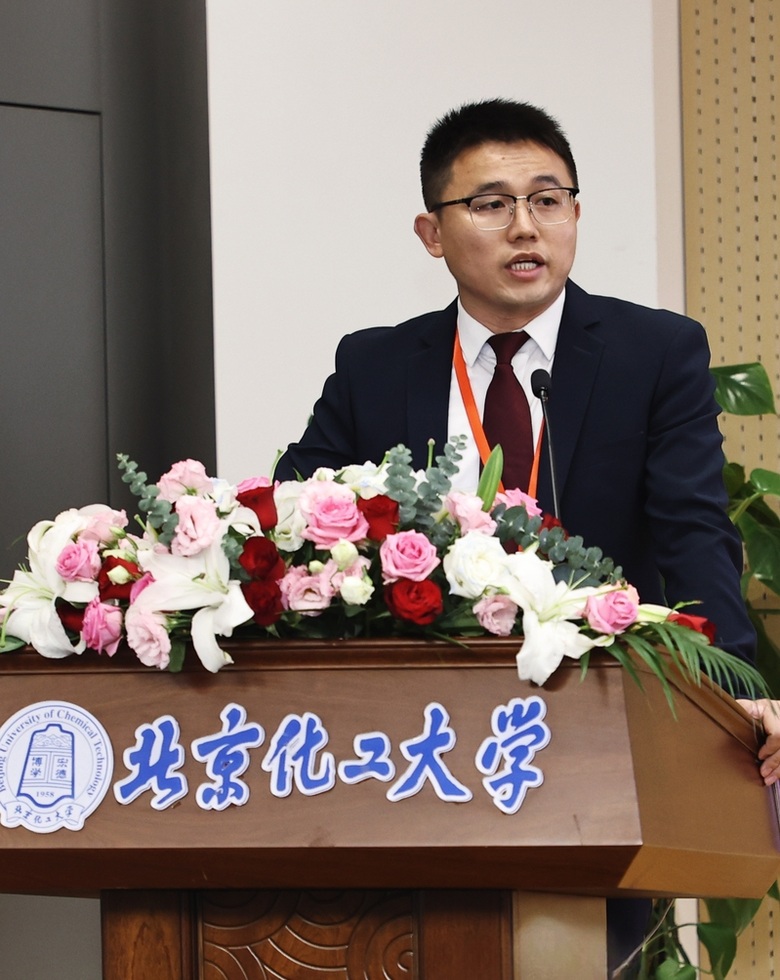
Zhiying Jiang
Associate Professor · Master’s Supervisor
BUCT Distinguished Young Teacher
Standing Committee Member, Technical Committee on Embodied Intelligence, Chinese Institute of Command and Control
College of Information Science and Technology
Beijing University of Chemical Technology
jiangzy@buct.edu.cn
AI in Education · Embodied Intelligence
Profile & Projects
Profile & Projects
Zhiying Jiang received his bachelor’s, master’s and doctoral degrees from Beijing University of Chemical Technology (BUCT), earning a doctorate in engineering. He joined BUCT in 2012. His research spans AI in education and embodied intelligence, with a focus on state understanding and decision support in dynamic interactions. He studies joint representations of environmental observations and past experience, with applications to learner-state diagnosis and instructional intervention in programming education, and to multimodal perception and spatial memory in embodied intelligence.
His projects are supported by the Beijing Natural Science Foundation, State Key Laboratory research funds, the Ministry of Education’s Industry–University Collaborative Education Programme, and commissioned research from enterprises and public institutions. He has authored more than 10 published or accepted papers as first or corresponding author in journals including IEEE Transactions on Intelligent Transportation Systems and Expert Systems with Applications.
He has taught Data Structures and Object-Oriented Programming for many years and developed the CHL intelligent teaching system and the TRACE learning evidence tracing system. His awards include the Second Prize for Higher Education Teaching Achievement in Beijing (eighth contributor), a Third Prize in the Beijing Young University Teachers’ Teaching Skills Competition, and a First Prize in the university competition. He served as deputy editor of a textbook published by Tsinghua University Press and supervised students who won five first prizes in national competitions.
Selected Projects as Principal Investigator
| Period | Project | Funding source | RMB 10,000 | Status |
|---|---|---|---|---|
| From Sep 2026 6-month contract | Knowledge Augmentation for Large Language Models and Tool-Calling Algorithms for Complex Tasks in the Chemical Engineering Domain | Enterprises and public institutions | 78.45 | Ongoing |
| Jul 2026–Jun 2029 | Diagnosing Authentic Learning and Designing Interventions in LLM-Assisted Programming Education | Beijing Natural Science Foundation | 30 | Ongoing |
| Dec 2025–Dec 2027 | Data Collection and Processing for Validation in Representative Scenarios | Research institute | 93.5 | Ongoing |
| Sep 2024–Sep 2026 | Visualisation of Marine Environmental Variables and Data Preprocessing | Research institute | 80 | Ongoing |
| Aug 2024–Aug 2025 | Identification and Analysis of Critical Nodes in Energy Networks | State Key Laboratory Research Fund | 30 | Completed |
| Jan 2024–Jan 2026 | LLM-Based Intelligent Teaching: A Study in Data Structures | University Key Teaching Reform Project | 2 | Completed |
| Jan 2023–Jan 2026 | Development of Domain-Specific Big Data Engineering Modules and Models | Research institute | 201.5 | Completed |
| Mar 2022–Mar 2024 | Development of a Multi-Device Platform for Integrated Asset Information Visualisation | Enterprises and public institutions | 180 | Completed |
Teaching and Curriculum Development
Undergraduate: Data Structures; Data Structures Laboratory; Object-Oriented Programming; C Programming, including English-medium instruction; and Mobile Internet Technology. He also contributes to Introduction to Artificial Intelligence. Postgraduate: Academic English Writing; Academic English Reading and Writing; and English for Specific Purposes.
Data Structures and Mobile Internet Technology are university-designated first-class undergraduate courses. Data Structures is also a model course for integrating civic and ethical education, while Mobile Internet Technology received support for delivery entirely in English. He served as deputy editor of University Computer Laboratory Guide (5th ed., Tsinghua University Press, 2025) and supervised three projects under the National College Student Innovation and Entrepreneurship Training Programme.
Publications & Honours
Selected Publications, Patents and Awards
Research Publications
[1] Jiang Z, Ji G, Dai Y, Doyle P, Gu W. Learning Multilayer Network Representation via Rotational Graph Convolutional Networks[J]. Expert Systems with Applications, 2027, 333: 134080.
[2] Yang H, Liu W, Qiao Y, et al. CrossRay3D: Geometry and Distribution Guidance for Efficient Multimodal 3D Detection[J]. IEEE Transactions on Intelligent Transportation Systems, 2026: 1–13 (Early Access).
[3] Han Z, Wang J, Yan X, et al. CoReaAgents: A Collaboration and Reasoning Framework Based on LLM-Powered Agents for Complex Reasoning Tasks[J]. Applied Sciences, 2025, 15(10): 5663.
[4] Jiang Z, Huang Z, Song C, et al. A Code-of-Thought Prompting Method for Coordinated Multi-Tool Invocation by Large Language Models[J]. Journal of Beijing University of Chemical Technology (Natural Science Edition), 2025, 52(3): 105–113. (in Chinese)
[5] Jiang Z, Zhang Z, Ji G, Li F. Food Safety News Summarization Paradigm Based On Large Language Models And RAG[C]//2025 IEEE 14th Data Driven Control and Learning Systems Conference (DDCLS). Wuxi, China: IEEE, 2025: 1681–1686.
Publications on Teaching and Learning
[6] Jiang Z, Ji G, Gu W. Exploring Generative AI-Enabled Teaching in Emerging Engineering Education: A Case Study of Object-Oriented Programming[J]. Educational Theory and Research, 2025, 3(40): 128–130. (in Chinese)
[7] Jiang Z, Wang J, Lu G, Doyle P, Gillespie B. A Blended Teaching Model Combining Customised MOOCs and Joint Chinese–International Classes[J]. Computer Education, 2023(10): 112–116. (in Chinese)
Granted Invention Patents
A representation learning method for improving the robustness of multilayer networks. CN120337984B. Granted in 2026. First inventor.
A Storm-based method for improving consistency in parallel computation of food data. ZL201810498850.7. Granted in 2021. First inventor.
Honours and Awards
| Year | Honour or award | Recipient / contribution |
|---|---|---|
| 2025 | Distinguished Young Teacher, Beijing University of Chemical Technology | Individual |
| 2022 | Second Prize, Beijing Higher Education Teaching Achievement Award Developing and Implementing an Innovative Computer Science Talent Development System for Chemical Engineering Universities in the Context of Emerging Engineering Education | Eighth contributor |
| 2021 | Third Prize, Engineering Group A, 12th Beijing Young University Teachers’ Teaching Skills Competition | Individual |
| 2020 | First Prize, 12th BUCT Young Teachers’ Teaching Skills Competition Best Live Presentation Award; Students’ Choice Award | Individual |
| 2020 | Outstanding Young Lecturer, Beijing University of Chemical Technology | Individual |
| 2015 | Third Prize, Beijing Division, 2nd National University Micro-Lesson Teaching Competition | Individual |
Perception & Memory
Research Area 1: Perception and Memory for Embodied Intelligence
This research examines how agents perceive dynamic environments through multiple modalities and use past experience. It focuses on image–point cloud fusion, temporal memory retrieval and spatial memory. Current work addresses multimodal 3D detection and explores the integration of LLM memory methods with visual spatial representations to acquire, retain and update environmental information.
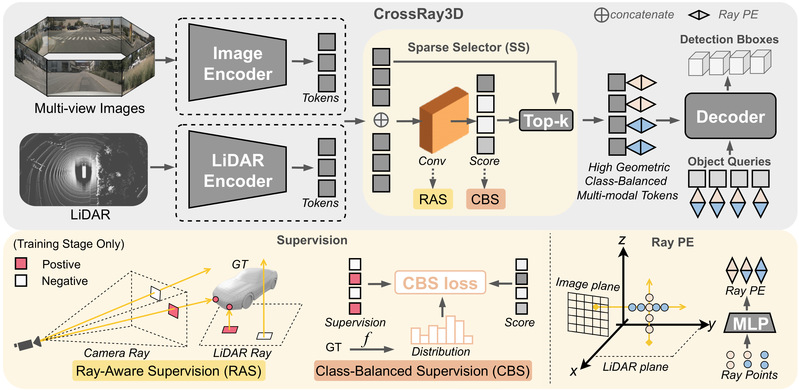
CrossRay3D: Multimodal 3D Perception
CrossRay3D improves image and point cloud sampling through ray-aware supervision, class-balanced supervision and sparse feature selection. Ray positional encoding aligns geometric information across modalities. The method achieves 72.4% mAP and 74.7% NDS on nuScenes and is evaluated for robustness under sensor loss.
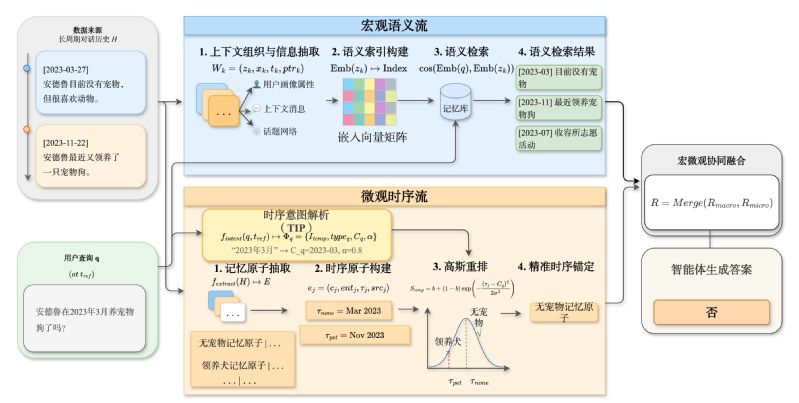
ChronoMem: Temporal Memory and Extensions to Spatial Memory
ChronoMem organises long-term conversational memory as events. Temporal intent parsing, Gaussian time-weighted reranking and retrieval of broader context address information conflicts and retrieval bias caused by changes over time. Ongoing work combines these methods with computer vision to investigate spatial relations among scenes, objects and past events, together with memory updating.
Graph Learning & Agents
Research Area 2: Graph Representation Learning and Agent Reasoning
This research develops representations of heterogeneous entities, interlayer relations and task dependencies, examining how relational modelling supports planning and tool execution. Graph representation learning integrates information from multiple sources, while multi-agent collaboration and knowledge augmentation support complex reasoning. Applications include energy network analysis and specialised problem solving.
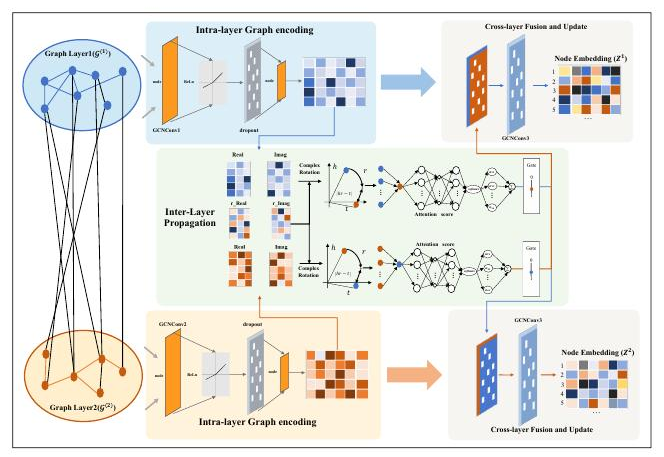
RT-GCN: Multilayer Network Representation Learning
RT-GCN combines within-layer graph encoding with rotations in complex space to model heterogeneous interlayer relations. Relation-aware attention and consistency gating regulate information fusion across layers. Link prediction and sparse-coupling experiments on four real-world two-layer networks evaluate the effectiveness and robustness of the learned representations.
CoReaAgents: Collaborative Multi-Agent Reasoning
CoReaAgents coordinates planning, tool and reflection agents through enhanced tool descriptions, subtask verification and dynamic replanning. It achieves an average pass rate of 77.2% on ToolBench, 4.0 percentage points above Tool-Planner. The collaboration mechanism is also evaluated on mathematical reasoning and multi-hop question answering.
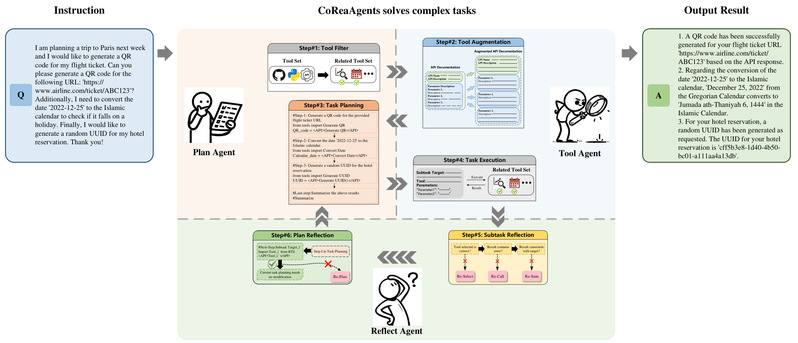
Related work includes ReACo for code-of-thought reasoning and coordinated tool invocation, critical node identification in energy networks, and knowledge augmentation and complex-task tool-calling algorithms for chemical engineering.
View publication
AI in Education
Research Area 3: AI in Education
This research investigates learning process representation, competence diagnosis and instructional intervention when students use generative AI. It examines how code, interaction logs, AI conversations and assessment results can inform teaching decisions and course improvement, drawing on heterogeneous cognitive networks and research on teacher feedback.
Learning Process Representation and Cognitive Diagnosis
Supported by a Beijing Natural Science Foundation project led by Jiang, this work constructs a three-layer heterogeneous network of knowledge, behaviour and cognition. It investigates diagnosis of learning states when external assistance is only partially observable and differentiated instructional interventions based on transitions between cognitive states.
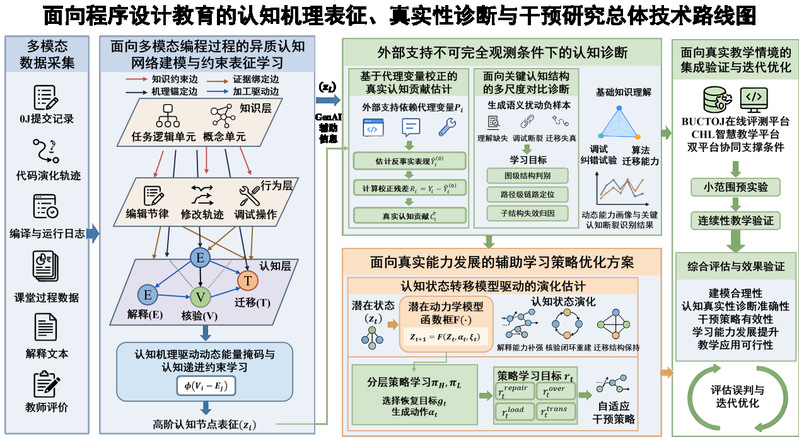
CHL Teaching Practice and TRACE Evidence Tracing
CHL organises learning through task cards, probing questions and programming exercises, supporting algorithm explanation, boundary-case verification and transfer to variations of a task. TRACE links teacher feedback to task conditions, AI assistance and student responses, enabling learners to inspect supporting evidence, provide clarification and contest feedback.
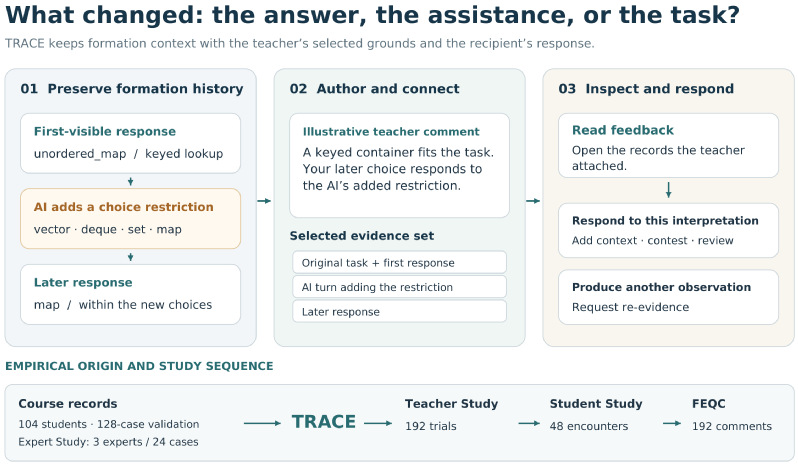
The TRACE study includes 192 tasks completed by 24 teachers and 48 interactions involving 16 students. Teachers consulted a broader range of evidence sources, and learners opened cited records in 40 of the 48 interactions. Specific, sufficient and task-aligned interpretations of evidence are central to feedback quality.