
On December 9 (Beijing Time), the Finals of the 2025 Intelligent Robot Competition concluded in Beijing. The team from Beijing University of Chemical Technology, guided by Professor Cao Zhengcai (Team Name: ZhiyinMingdeng; Team Leader: Sun Yiyang; Team Members: Xia Ji, Mu Hongmin, Shao Shibo, Li Junnian), won the first prize in the fiercely competitive "Rehabilitation Robot Operation Task Challenge" under the Rehabilitation and Elderly Care Track, by virtue of their solid professional skills.
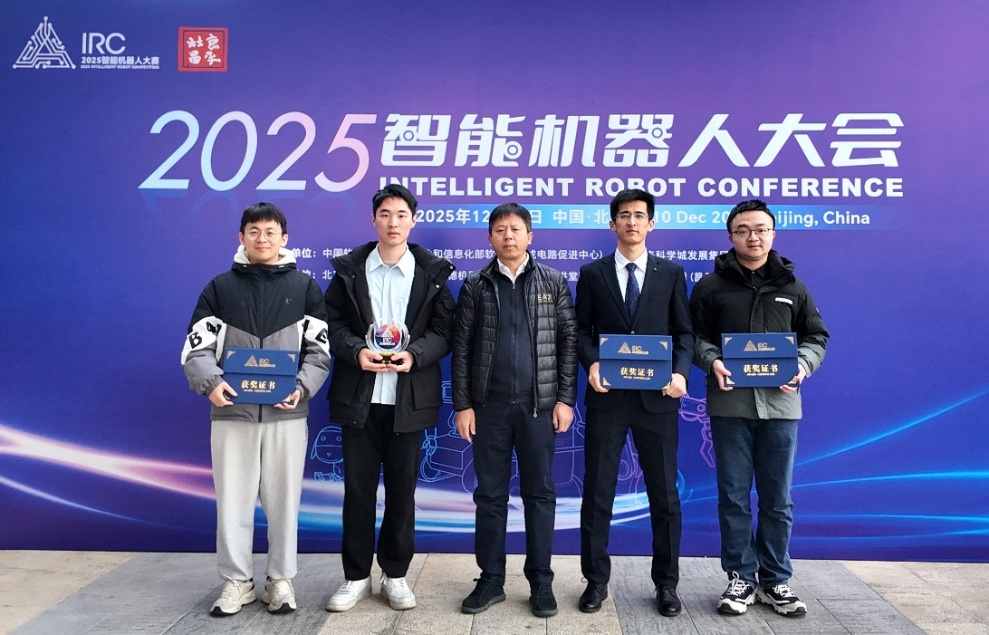
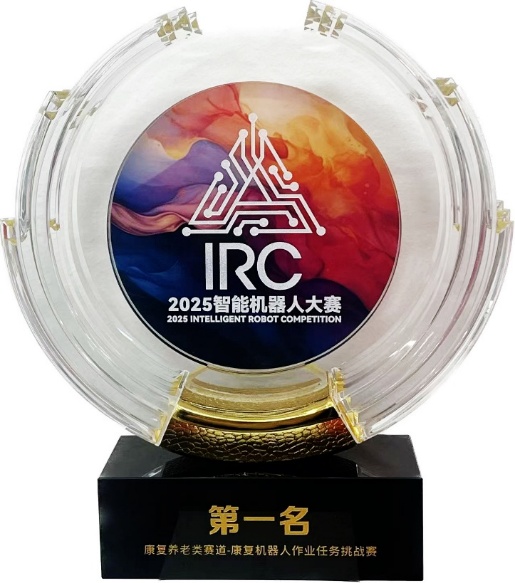
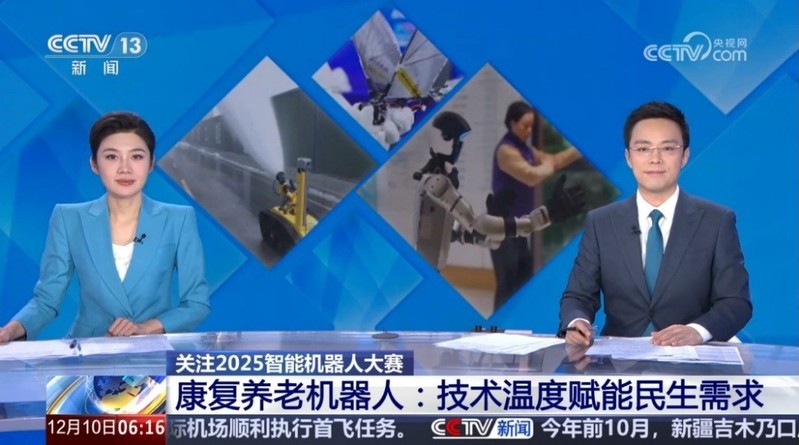
Co-hosted by China Software Testing Center (Software and Integrated Circuit Promotion Center of the Ministry of Industry and Information Technology) and Beijing Future Science City Development Group Co., Ltd., this competition attracted a large number of leading intelligent robot enterprises, universities and research institutes nationwide, including JAKA Robotics, Citic Heavy Industries Kaicheng Intelligence, Humanoid Robotics Technology, Songyan Power Technology, Peking University and Institute of Automation of the Chinese Academy of Sciences. A total of 73 teams advanced to the final round. Focusing on real industrial demands, the finals adopted an innovative competition system featuring "autonomous tasks and scenario-driven challenges", which comprehensively assessed the participating robot teams' application capabilities in key fields such as manufacturing, healthcare and elderly care, and emergency response. It has injected strong impetus into the large-scale implementation and high-quality development of China's intelligent robot industry.
To address the travel needs of visually impaired individuals, the "Wisdom Guiding the Light" team developed an integrated wearable intelligent navigation robot for the visually impaired based on "visual reasoning, autonomous navigation and multi-sensory interaction". The robot was designed to tackle the drawbacks of existing assistive devices for the visually impaired, such as weak cognitive ability, over-reliance on dense prior maps and simplistic interaction modes. It enables visually impaired people to walk independently in unfamiliar environments, fully demonstrating the innovative thinking and technological breakthroughs of students from Beijing University of Chemical Technology in the fields of artificial intelligence and robotics.