
On February 21, the acceptance results for the IEEE/CVF Conference on Computer Vision and Pattern Recognition (CVPR 2026) were officially released. The research paper titled ClimaOoD: Improving Anomaly Segmentation via Physically Realistic Synthetic Data by Professor Li Zheng’s team was successfully accepted.
CVPR is one of the most influential top international conferences in the field of computer vision. CVPR 2026 received a total of 16,092 valid submissions, of which 4,090 papers were recommended for acceptance, representing an overall acceptance rate of 25.42%.
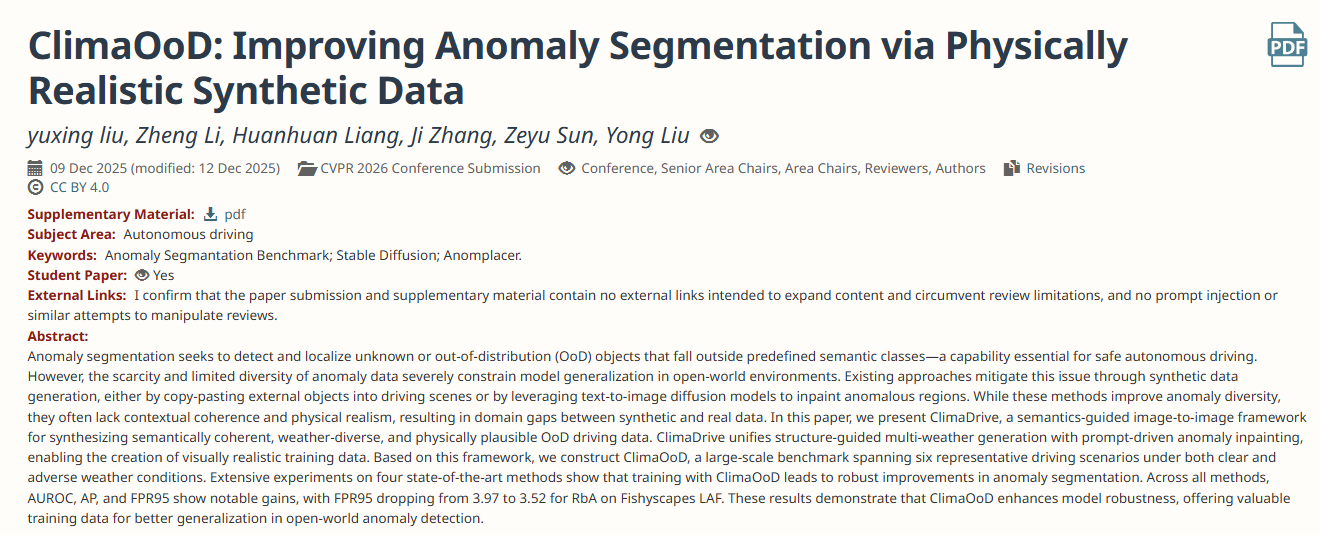
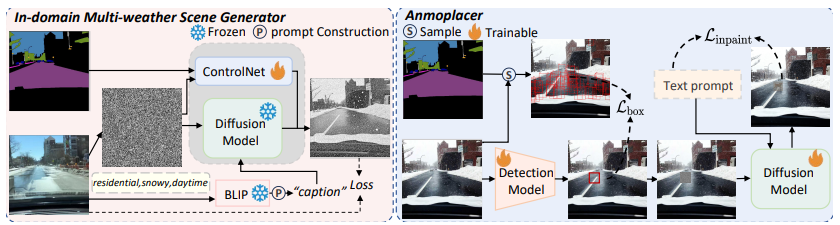
This paper focuses on the problem of Open-world Anomaly Segmentation in open-world autonomous driving scenarios.To address key challenges including the scarcity of abnormal samples, the limited diversity in weather and scene distributions of real-world data, and significant shortcomings of existing synthesis methods in spatial layout and physical consistency, the authors propose ClimaDrive, a semantic-constraint-driven image-to-image generation framework.By incorporating semantic maps and structure-guided mechanisms, this framework enables controllable anomaly injection across various weather conditions, generating high-quality training data while ensuring spatial rationality and physical consistency.
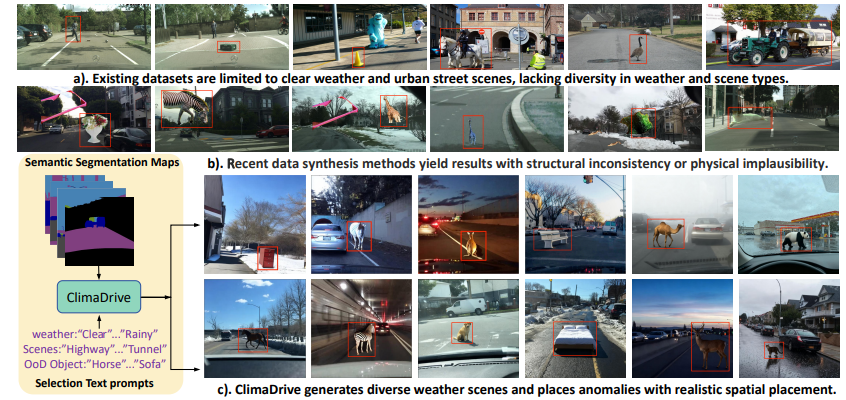
Based on this generation framework, the team further constructed ClimaOoD, a large-scale training benchmark dataset covering diverse driving scenarios and complex weather conditions.Experimental results demonstrate that after training with ClimaOoD, multiple mainstream anomaly segmentation models achieve significant performance improvements on authoritative benchmarks such as Fishyscapes.Key metrics including AP and FPR95 are comprehensively enhanced, and the models exhibit stronger robustness and generalization ability, especially under complex weather and extreme scenarios.The experimental results validate the critical value of physically consistent synthetic data for improving the generalization capability of open-world visual models.
The first author of this paper is Liu Yuxing, a PhD student of the 2025 cohort in the School of Information. The work was co supervised by Professor Li Zheng and Professor Liu Yong.
Beijing University of Chemical Technology is the first affiliation of the paper. Collaborative institutions include the Institute of Software, Chinese Academy of Sciences, and Southwest Minzu University.
This research was supported by the National Natural Science Foundation of China and the Huawei Populus Euphratica Fund, among other projects.