
Recently, the research paper Adaptive small-family population-guided swarm intelligence optimization algorithm by the team of Professor Geng Zhiqiang and Professor Han Yongming from our school has been officially published in Science China Information Sciences, a top journal recognized as CCF Class A and T1.
Dr. Wang Xintian from the School of Information Science and Technology is the first author, and Professor Geng Zhiqiang and Professor Han Yongming are the corresponding authors.Beijing University of Chemical Technology is the first affiliation, and Harvard Medical School is the collaborative institution.
This research was supported by the National Natural Science Foundation of China, the Key Research and Development Program of Xinjiang Uygur Autonomous Region, and other projects.
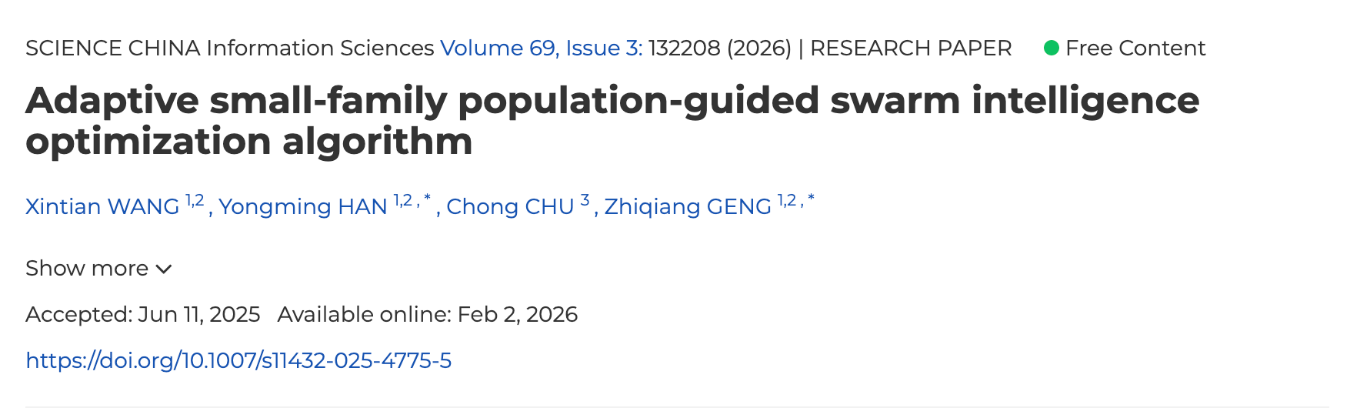
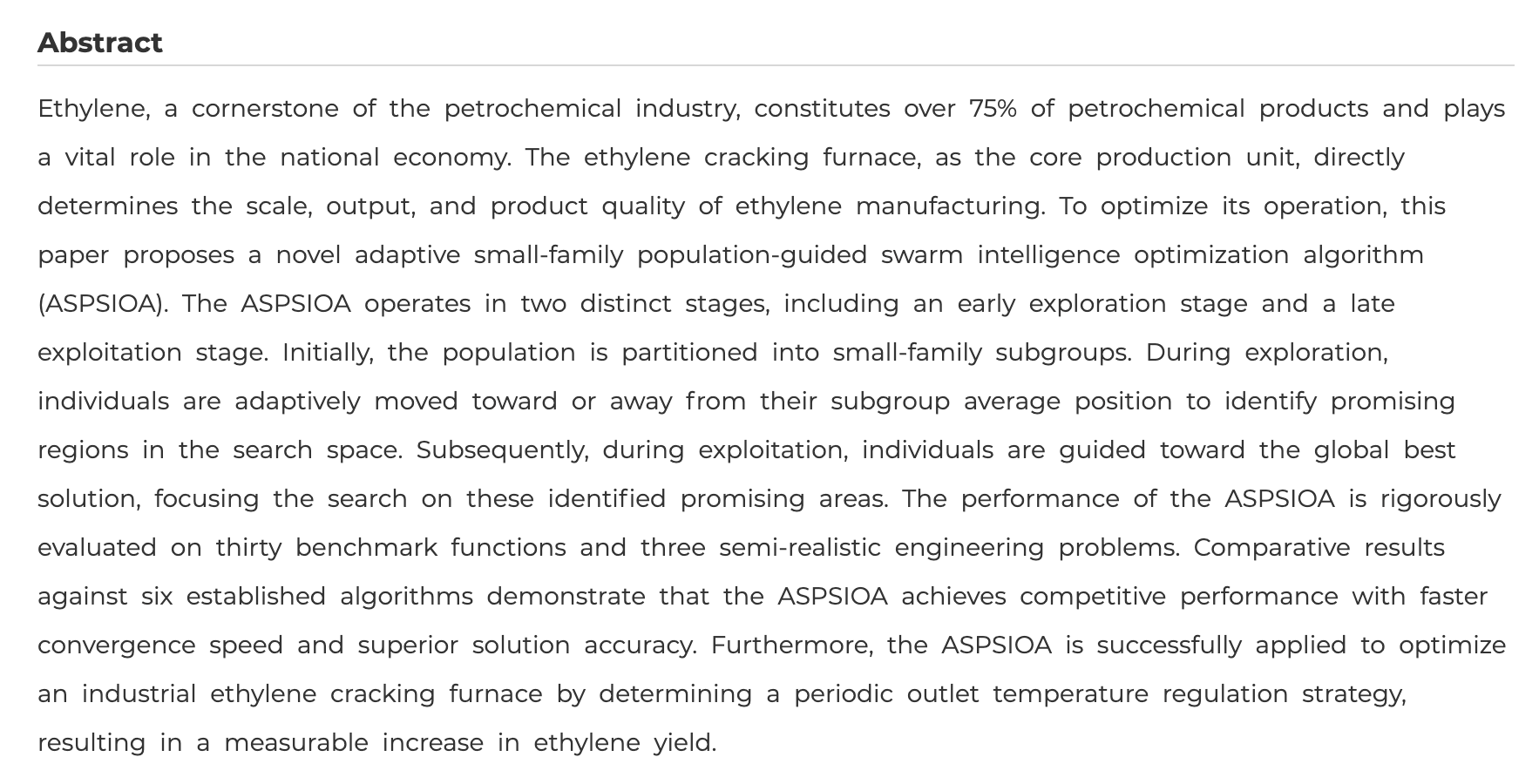
Ethylene is the core raw material of the petrochemical industry. As the key production unit, the ethylene cracking furnace plays a crucial role in industrial development through operational optimization.
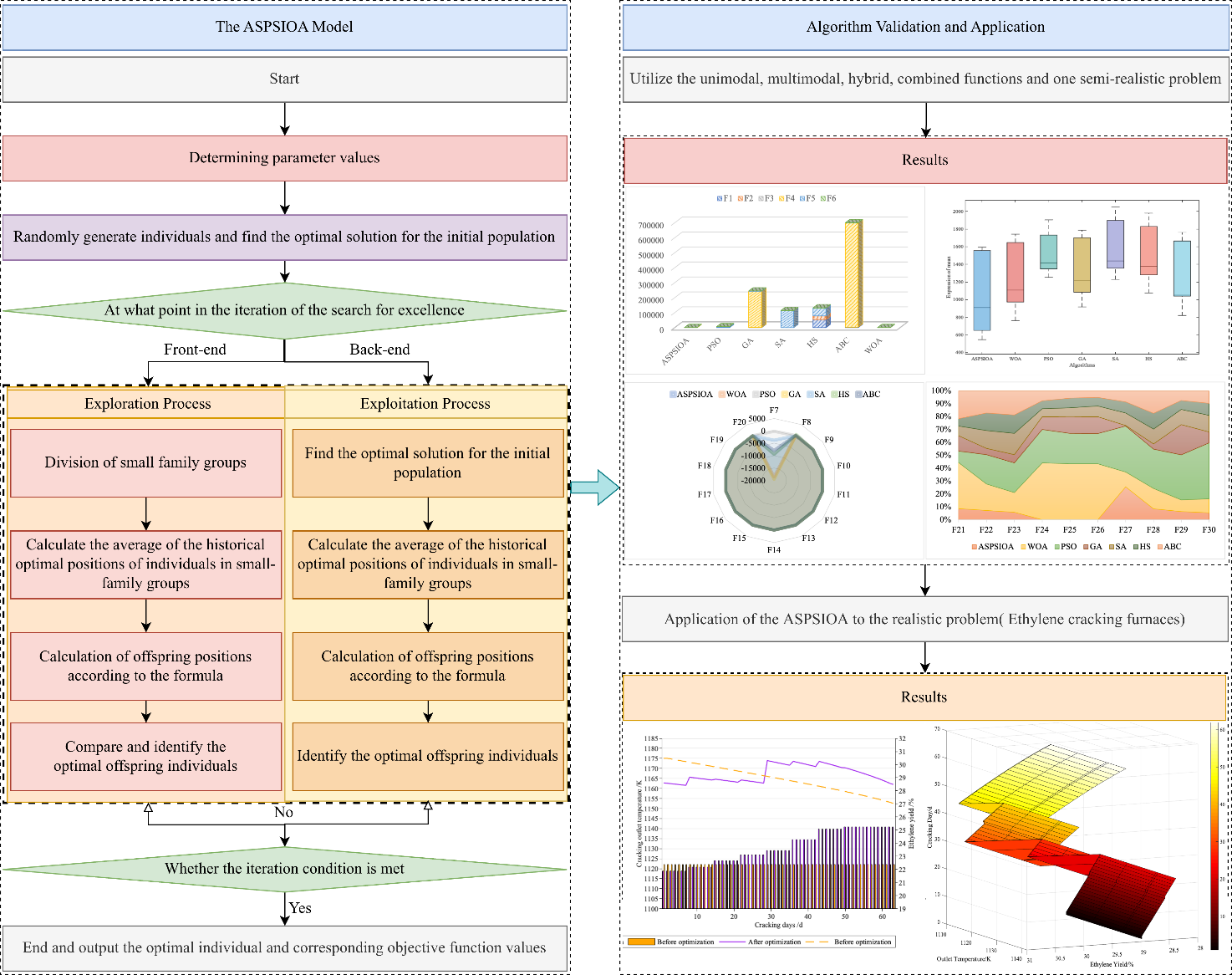
To address the problems of existing metaheuristic optimization algorithms, such as being prone to local optima, an imbalance between exploration and exploitation, and unstable performance in swarm intelligence optimization algorithms, the research team proposed an Adaptive Small Family Population Guided Swarm Intelligence Optimization Algorithm (ASPSIOA).
This algorithm innovatively adopts a two stage search strategy: it first divides the population into small family subgroups to complete global exploration, and then guides individuals to conduct precise exploitation toward the global optimal solution. Combined with a natural logarithm update rule, it achieves adaptive adjustment of control factors, balancing global exploration and local exploitation.
Tested on multiple standard benchmark functions and semi real engineering problems, and compared with other intelligent optimization algorithms, ASPSIOA shows significant advantages in convergence speed, solution accuracy and stability, whose superiority is also confirmed by statistical tests.
Applied to the optimization of industrial ethylene cracking furnaces, the algorithm designs an optimal periodic outlet temperature control strategy, which effectively alleviates furnace tube coking, improves ethylene yield significantly, and provides a practical technical solution for the operation of petrochemical enterprises.
The core innovations of this study lie in three aspects: integrating the small family population structure with a two stage strategy, designing an adaptive weight adjustment mechanism, and verifying the practical industrial application value of the algorithm.
Science China Information Sciences is a top international English academic journal sponsored and administered by the Chinese Academy of Sciences. It is a CCF Class A core journal and a high quality T1 journal recommended by the China Computer Federation. It has long been located in JCR Q1, with its impact factor rising continuously.
The journal is indexed by authoritative international databases including SCI, EI and SCOPUS, and ranks among the top in Google Scholar’s influence list for artificial intelligence. Its editorial board consists of leading global experts in information science, focusing on original fundamental theories and breakthroughs in major engineering applications.
Through in depth cooperation with Springer Nature, the journal enjoys extensive global dissemination and attracts high quality submissions from top international universities and renowned enterprises. It leads similar journals worldwide in citation rate and academic influence, serving as an important platform for publishing and exchanging academic achievements in information science.
The publication of this research in the journal demonstrates the team’s solid foundation and outstanding ability in integrating algorithm innovation with engineering applications.
In the future, the research team will further expand the multi objective optimization capability of the algorithm, build a more complete energy consumption model for industrial processes combined with digital twin technology, and promote the application of intelligent optimization algorithms in more industrial fields such as photovoltaic power generation and catalytic cracking. This will provide stronger technical support for the efficient and intelligent operation of process industries.