
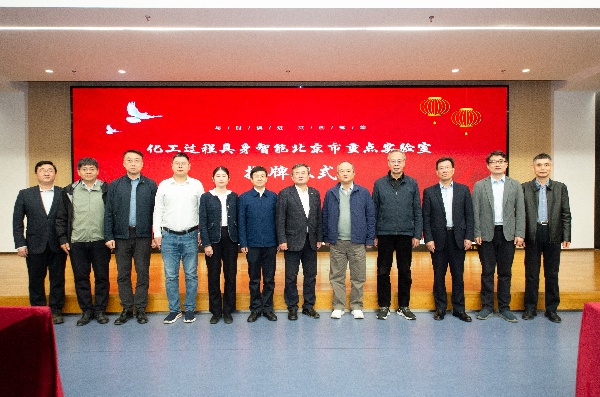
On March 15, the Symposium on Embodied Intelligence for Chemical Processes was successfully held in the Multi-Function Hall of the Conference Center at Beijing University of Chemical Technology (BUCT). The inauguration ceremony of the Beijing Key Laboratory of Embodied Intelligence for Chemical Processes was conducted concurrently.
Hosted by BUCT, the conference brought together top experts, scholars and industry leaders in the fields of artificial intelligence, automation and chemical engineering. Participants held in-depth discussions on cutting-edge theories, technological research and industrial applications of embodied intelligence for chemical processes, pooling wisdom and strength to advance the deep integration of AI and the traditional chemical industry, and foster new quality productive forces in the chemical sector.
Guests and officials in attendance included Wang Feng, Vice President of BUCT; Wu Feng, Member of the Chinese Academy of Engineering and Vice President of University of Science and Technology of China; Sun Tiecheng, General Manager of China National Chemical Engineering Digital Intelligence Technology Co., Ltd.; and Li Tianqi, Deputy Director of the Information Technology Division, Beijing Municipal Science and Technology Commission. Also present were Feng He, Secretary of the Party Committee of the School of Information Science and Technology, Professor Wang Youqing, Dean of the School, Yu Le, Deputy Director of the Office of Planning and Discipline Development at BUCT, as well as faculty and student representatives. The event was moderated by Feng He.
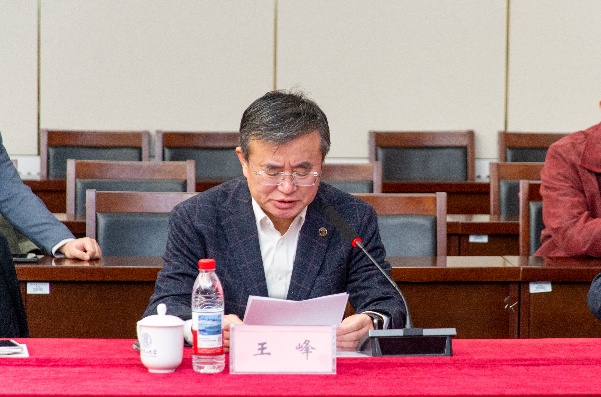
The symposium officially opened at 9:00 a.m. Vice President Wang Feng delivered the opening speech, extending a warm welcome to all leaders and experts. He outlined BUCT’s academic strengths in chemical engineering and its strategic layout for interdisciplinary integration with artificial intelligence. He emphasized that the symposium and the laboratory inauguration are important measures for the university to respond to the national science and technology development strategy and align with Beijing’s industrial planning.
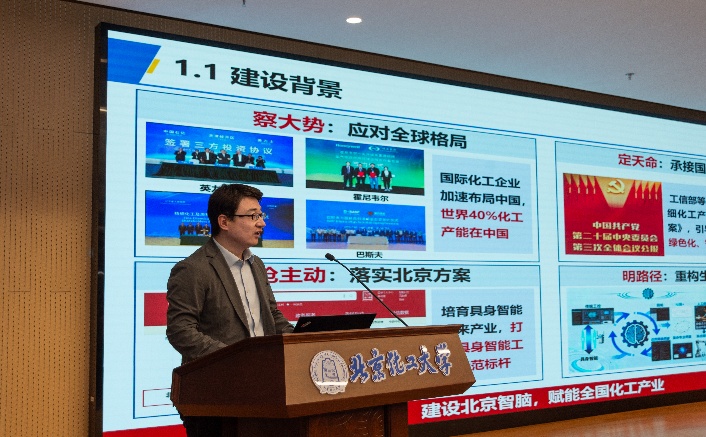
Subsequently, Li Tianqi, Deputy Director of the Information Technology Division, Beijing Municipal Science and Technology Commission, addressed the conference. He commended BUCT’s exploration and practices in integrating chemical engineering with intelligent technologies, and expressed high expectations for the newly established Beijing Key Laboratory of Embodied Intelligence for Chemical Processes. He hoped the laboratory would base itself in Beijing, serve the whole nation, and provide core technological support for the digital transformation of the chemical industry.
In the laboratory introduction session, Professor Wang Youqing, Dean of the School of Information Science and Technology at BUCT and Director of the Beijing Key Laboratory of Embodied Intelligence for Chemical Processes, gave a special report. He detailed the laboratory’s founding background, supporting institution and collaborative partnership model, and defined its four core research directions:
Embodied perception of chemical equipment
Autonomous decision-making for chemical systems
Collaborative interaction of chemical equipment
Intelligent prevention and control of chemical processes
He noted that the laboratory, relying on the School of Information Science and Technology at BUCT, will deepen university-enterprise cooperation with China National Chemical Engineering Digital Intelligence Technology Co., Ltd., bridging the “last mile” between cutting-edge theories and industrial applications.
A panel of renowned domestic experts served as consultants, providing professional guidance for the development of embodied intelligence for chemical processes and the construction of the laboratory. They included Wu Feng (Member of the Chinese Academy of Engineering, Vice President of USTC), Duan Haibin (Beihang University), Tan Min (Institute of Automation, Chinese Academy of Sciences), Wang Dayi (Beijing Institute of Spacecraft System Engineering), Wang Ling (Tsinghua University) and Zhu Xiongqun (BUCT).
In the keynote session, Cao Liang, researcher at the University of British Columbia and Massachusetts Institute of Technology, delivered a speech titled Trustworthy Artificial Intelligence for Chemical Processes – Modeling, Monitoring and Control. Addressing pain points of AI models in complex chemical processes, he systematically elaborated theories and methodologies of trustworthy AI, and shared application achievements in digital twins for refineries.
Li Longchuan, Associate Professor at BUCT, gave a presentation entitled Embodied Morphological Intelligence – From Wooden Ox and Flowing Horse to Transformers. He proposed a new intelligent perspective of embodied morphological intelligence and discussed its significance and prospects for cross-domain application from robotics to process industries.
After the presentations, participating experts engaged in in-depth exchanges and offered valuable suggestions on technological research and practical applications of embodied intelligence for chemical processes.
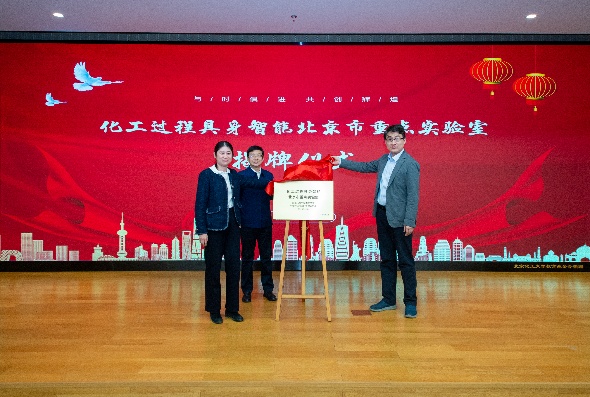
During the symposium, the inauguration ceremony of the Beijing Key Laboratory of Embodied Intelligence for Chemical Processes was held. Li Tianqi, Professor Wang Youqing, Sun Tiecheng and other guests jointly unveiled the plaque, marking a milestone for BUCT in the deep integration of artificial intelligence and the traditional chemical industry. The laboratory also establishes a key scientific research and innovation platform for the intelligent upgrading of Beijing’s chemical industry.
The Beijing Key Laboratory of Embodied Intelligence for Chemical Processes will closely follow national strategic needs and Beijing’s industrial layout. It will focus on the deep integration of embodied intelligence theories into chemical scenarios, break through limitations of traditional industrial intelligent systems, and form a new paradigm of chemical intelligence featuring environmental embedding and autonomous evolution.
Going forward, the laboratory will gather outstanding researchers from home and abroad, deepen collaborative innovation between universities and enterprises, and strive for a series of original breakthroughs in embodied intelligence for chemical processes. It will provide solid scientific and technological support as well as talent guarantee for the digital transformation and intelligent upgrading of the chemical industry in Beijing and nationwide, boosting the high-quality development of the chemical sector.