
Recently, the international standard ISO/TS 19124-2:2025 Geographic information — Calibration and validation of remote sensing data and products — Part 2: SAR, co-developed by Associate Professor Yin Qiang of our college, has been officially released (https://www.iso.org/standard/85496.html). It took three years from project initiation to publication, marking the first international standard developed with the participation of our college. Relevant achievements have been reported by the National Geomatics Center of China, Aerospace Information Research Institute (AIR) of Chinese Academy of Sciences, Sohu, and other institutions and media.
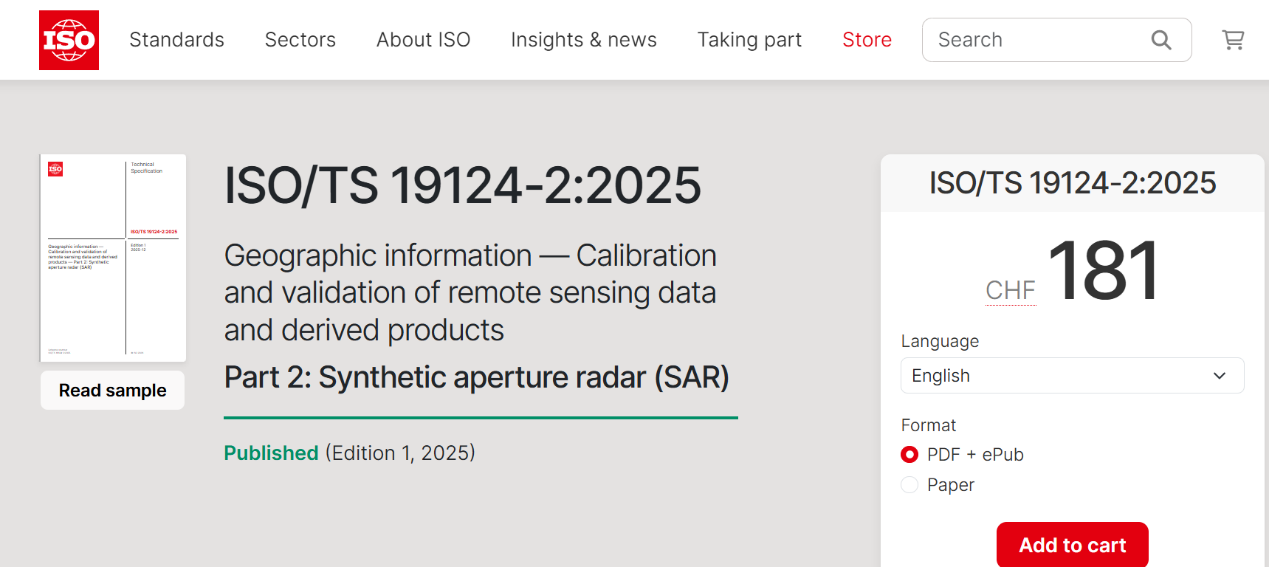
Led by the Aerospace Information Research Institute (AIR), Chinese Academy of Sciences, this standard was formulated through collaboration between experts from Beijing University of Chemical Technology, North China University of Technology and other domestic institutions, together with experts from the United States, Canada, Germany, Japan, Australia, South Africa, the United Kingdom and other countries. As the first standard in the ISO 19124 series targeting a specific sensor, it aims to systematically regulate the full workflow of calibration and validation for SAR sensor data and products.
The project is led by Professor Hong Wen, researcher at AIR and visiting professor at Beijing University of Chemical Technology. As a registered ISO expert and core participant, Associate Professor Yin Qiang was responsible for drafting and revising the standard sections covering multi-polarization SAR and scatter change products.
Responding to the development trend of SAR systems toward multi-polarization, multi-angle, multi-temporal, multi-frequency coordinated observation and satellite constellations, the standard fully covers calibration requirements for multi-dimensional system parameters including polarization, angle, time phase and frequency. Notably, it for the first time integrates new SAR data products such as 3D imaging products and scatter time-series dynamic change products into a unified calibration and validation framework, providing solid standardization support to enhance the scientific application value and sharing capability of China’s SAR remote sensing data.