
Recently, the acceptance results of the 43rd International Conference on Machine Learning (ICML 2026) have been released. Two research papers by Professor Wang Youqing’s team from our college, entitled Deep Multi-view Graph Clustering via Attribute-aware Bidirectional Structural Refinement and Pseudo-label Guided Multi-level Fusion and Dual-channel Dynamic Graph Neural Networks with Adaptive Adjacency Learning and Multi-scale Representation Fusion, have been successfully accepted. Beijing University of Chemical Technology is the first affiliation, and the University of Sydney and Shenzhen Institute of Advanced Technology, Chinese Academy of Sciences are the cooperative institutions. In the past year, Professor Wang Youqing’s team has continuously published academic papers at NeurIPS, ICLR and ICML, the three top international conferences in machine learning and artificial intelligence.
Research 1: Deep Multi-view Graph Clustering via Attribute-aware Bidirectional Structural Refinement and Pseudo-label Guided Multi-level Fusion
First author: Professor Wang Youqing (graduate supervisor); Second author: Zhao Tianxiang (2024 Master’s student, School of Information Science and Technology); Corresponding author: Associate Professor Guo Jipeng (co-supervisor)
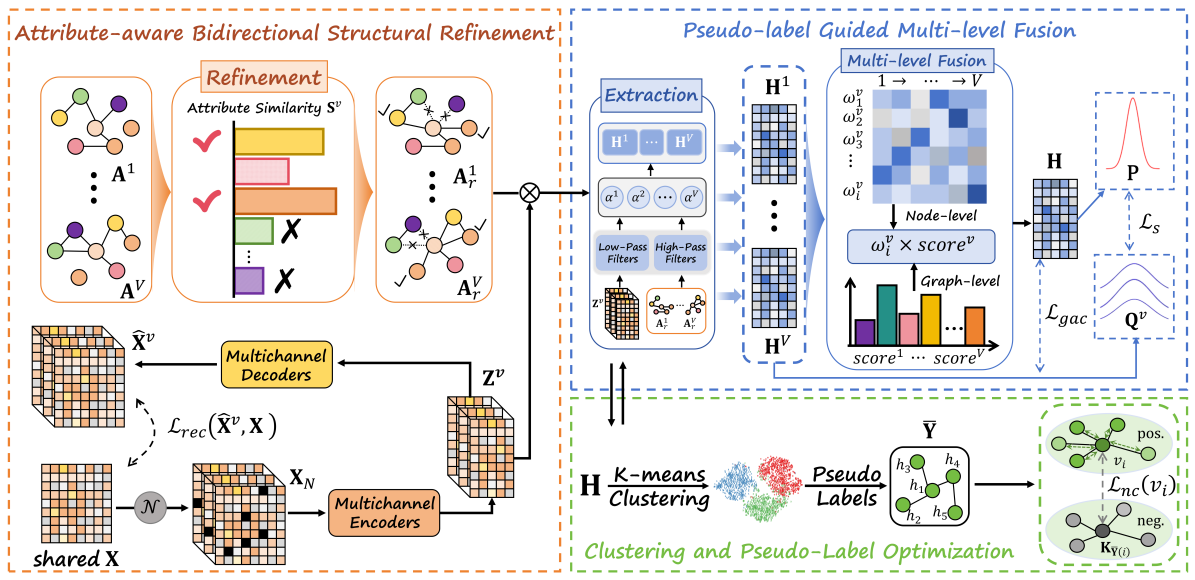
This study addresses the problems that existing methods overly rely on static local topological structures and lack node-level adaptive perception in cross-view fusion strategies, and proposes a novel deep multi-view graph clustering method (APGC). Existing methods mainly perform message passing based on the original adjacency matrix, ignoring the dynamic correction of topological structures by global attribute semantics. In addition, these methods adopt coarse-grained view-level weighting schemes, neglecting the contribution differences of different views at the node granularity, which limits the discriminative ability of consensus representations.
APGC implements an attribute-aware bidirectional structure refinement strategy, which dynamically strengthens high-quality connections and suppresses semantically conflicting relationships using attribute similarity, realizing the deep collaboration between global attribute semantics and local topological structures, and providing a new idea to effectively alleviate the learning bottleneck caused by the homophily assumption. Furthermore, through a pseudo-label guided multi-level fusion design, APGC collaboratively optimizes weight assignment in both node and view dimensions, significantly enhancing the discriminability of consensus representations and effectively improving model performance.
Research 2: Dual-channel Dynamic Graph Neural Networks with Adaptive Adjacency Learning and Multi-scale Representation Fusion
First author: Professor Wang Youqing (graduate supervisor); Second author: Long Jiahao (2023 Master’s student, School of Information Science and Technology); Corresponding author: Associate Professor Guo Jipeng (co-supervisor)
To comprehensively and effectively mine potential semantic and structural information in heterogeneous graphs, this study proposes a novel dual-channel dynamic graph neural network framework (DCD-GNN). Its core idea is to separately learn dynamic adaptability and structural stability through a dual-channel parallel architecture, achieving the optimal fusion of multi-level and multi-scale structural information.
Specifically, the dynamic channel contains two complementary sub-channels (high-frequency and low-frequency), which explore multi-level semantic correlations between arbitrary nodes using the self-attention mechanism. Then, low-frequency structural filtering and high-frequency detail capturing are adaptively fused to fully capture potential semantic and structural patterns in the full frequency domain. The static channel is responsible for maintaining structural stability, extracting explicit topological information while preventing structural distortion caused by excessive dynamic adjustment. In addition, DCD-GNN adopts a multi-scale representation fusion mechanism, fully considering the contributions of different scale embeddings to the final representation, enabling the model to adaptively determine the degree of information dependence according to specific graph structures and task requirements.

ICML (International Conference on Machine Learning) is one of the top international conferences in machine learning and artificial intelligence, and a Class A conference recommended by the China Computer Federation (CCF). Together with the International Conference on Learning Representations (ICLR) and the Conference on Neural Information Processing Systems (NeurIPS), ICML is known as the "three major conferences" with the highest difficulty, level and influence in artificial intelligence and machine learning. ICML 2026 received 23,918 valid submissions, with an overall acceptance rate of 26.6%. This acceptance marks another progress of our college in the field of artificial intelligence.
This research is supported by the Beijing Key Laboratory of Embodied Intelligence for Chemical Processes, the Interdisciplinary Research Center for Artificial Intelligence and Green Chemical Engineering, and funded by projects such as the National Natural Science Foundation of China.