
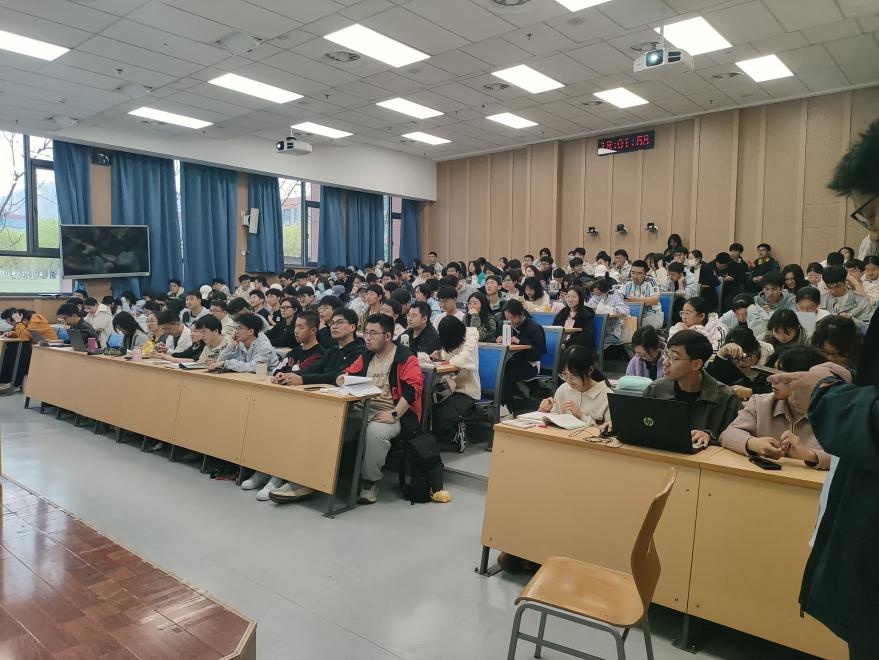
Against the backdrop of in-depth integration of smart manufacturing and industrial Internet, to deepen students’ understanding of cutting-edge advances in artificial intelligence and optimization algorithms and cultivate their interdisciplinary innovation capabilities, our school invited Professor Wang Ling to deliver an academic lecture titled Intelligent Optimization Algorithms and Their Applications in the No.1 Teaching Building on Changping Campus on the evening of April 13. Nearly 200 teachers and students attended the event.
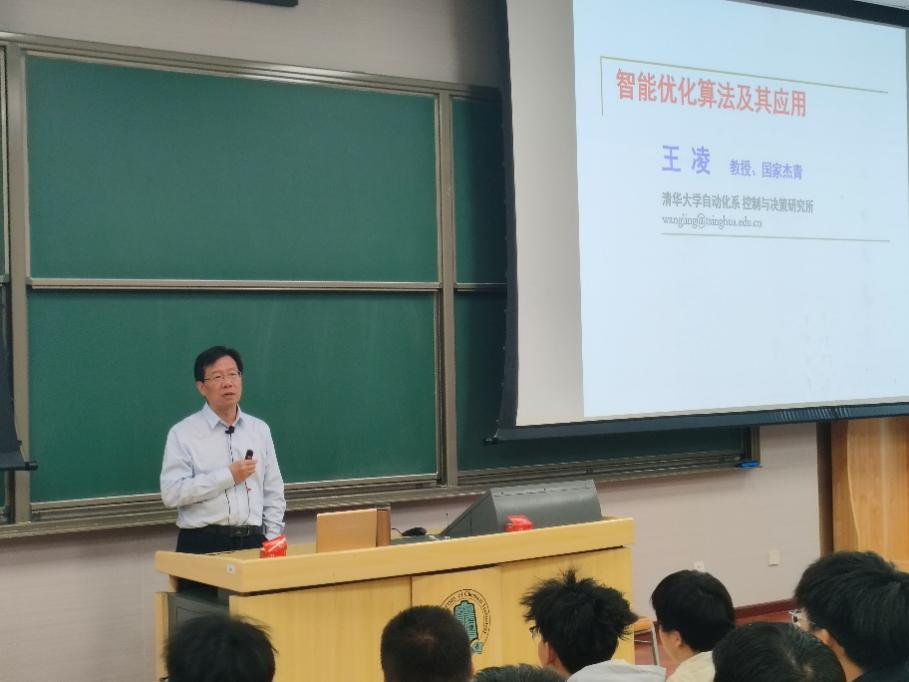
Professor Wang Ling holds a tenured professorship in the Department of Automation, Tsinghua University, serves as a doctoral supervisor and Vice Chair of the Department Degree Committee. He is the lead instructor for the national top-quality course Principles of Automatic Control, Executive Vice President and Fellow of the China Simulation Federation, Honorary Director of the Special Committee on Intelligent Simulation, Optimization and Scheduling, and recipient of the National Science Fund for Distinguished Young Scholars.
During the lecture, Professor Wang elaborated that intelligent optimal scheduling acts as the core component of manufacturing systems. It effectively drives industrial upgrading, cuts costs and reduces operational burdens, and serves as a linchpin for advancing high-end, intelligent and green industrial development. Targeting the complex optimal scheduling challenges in industrial and service processes, Professor Wang and his team analyzed the necessity of data-driven intelligent optimization. He illustrated the fundamental principles and implementation procedures of intelligent optimization, as well as the framework and core modules of integrated intelligent optimization. Several key issues were dissected from the perspectives of system theory, information theory and cybernetics, and he presented representative research achievements in intelligent optimization theory, intelligent constrained optimization and intelligent scheduling.
In the Q&A session, Professor Wang discussed the future evolution of intelligent optimization with students. The meta-Harness framework proposed by Stanford University enables deep integration of large language models and intelligent agents. It allows AI agents to tune operational parameters via automated optimization pipelines for performance improvement. He also shared prospects on the combination of intelligent optimization and quantum computing to accelerate machine learning model training and tackle combinatorial optimization problems. Furthermore, he encouraged students to build a solid foundation of professional knowledge, conduct in-depth research in fields matching their interests, stay grounded and guard against impetuosity and conceit.
Integrating theories with real-world practices, Professor Wang’s presentation helped students gain a clearer and more comprehensive grasp of artificial intelligence and optimization algorithms. The lecture concluded successfully.