
Recently, the National Final of the 13th National University Electrical and Electronic Basic Course Experimental Teaching Case Design Competition (Siglent Cup) successfully concluded at Shanghai Jiao Tong University. Relying on solid teaching proficiency, interdisciplinary innovative thinking and rigorous practical design, the faculty team from the Electrical & Electronic Engineering Center of the School of Information Science and Technology claimed one National First Prize (Best Creative Award) and one National Second Prize. This marks the best performance of our university in this competition, fully demonstrating the university’s strong strength and leading position in the reform and innovation of electrical and electronic experimental teaching.
As a benchmark competition in the field of experimental teaching of fundamental electrical and electronic courses nationwide, the Siglent Cup is co-sponsored by the Sub-Committee of Electrical and Electronic Basic Courses of the Ministry of Education, China Electronic Education Association, and the Electronics Discipline Group of the National Joint Council of National Experimental Teaching Demonstration Centers. Included in the data source of the University Teaching Competency Ranking by the Chinese Society of Higher Education, it serves as a core authoritative platform for evaluating the basic teaching quality of electrical and electronic courses and teachers’ innovative teaching capacity in universities.
This year’s competition drew active participation from more than 200 universities across five major competition regions (North China, Northern China, Western China, Central-South China and East China), receiving a total of 673 entries. After multiple rounds of rigorous evaluation and tiered screening by expert panels of organizing committees from the five regions, only 177 outstanding cases qualified for the national final. During the final, participating teams competed on the same stage and showcased their strengths. Judges conducted strict assessments based on core criteria including innovativeness of teaching design, practical operability and teaching demonstration value. In the end, 36 First Prizes, 52 Second Prizes and 84 Third Prizes were awarded, with the First Prize winning rate standing at merely 5.3%, reflecting fierce competition. Notably, to highlight innovation-driven development, the competition specially selected high-value special individual awards from the 36 first-prize works: one overall Siglent Cup Grand Prize, two Best Creative Awards, two Best Engineering Awards and two Best Lecture Awards. These prestigious honors represent the top tier among all first-prize entries.
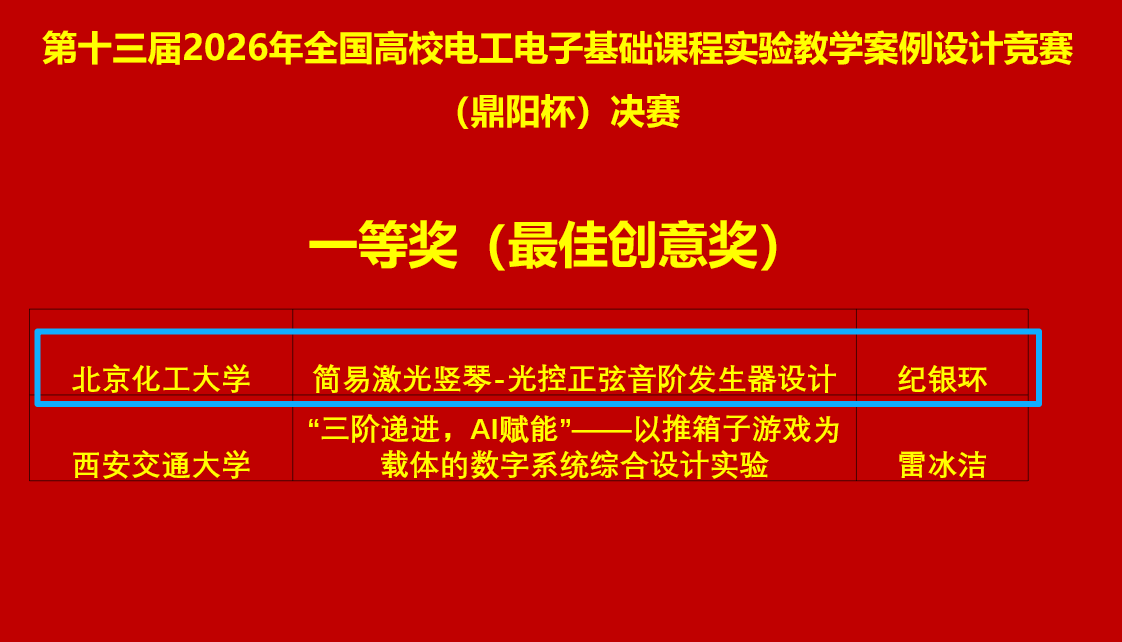
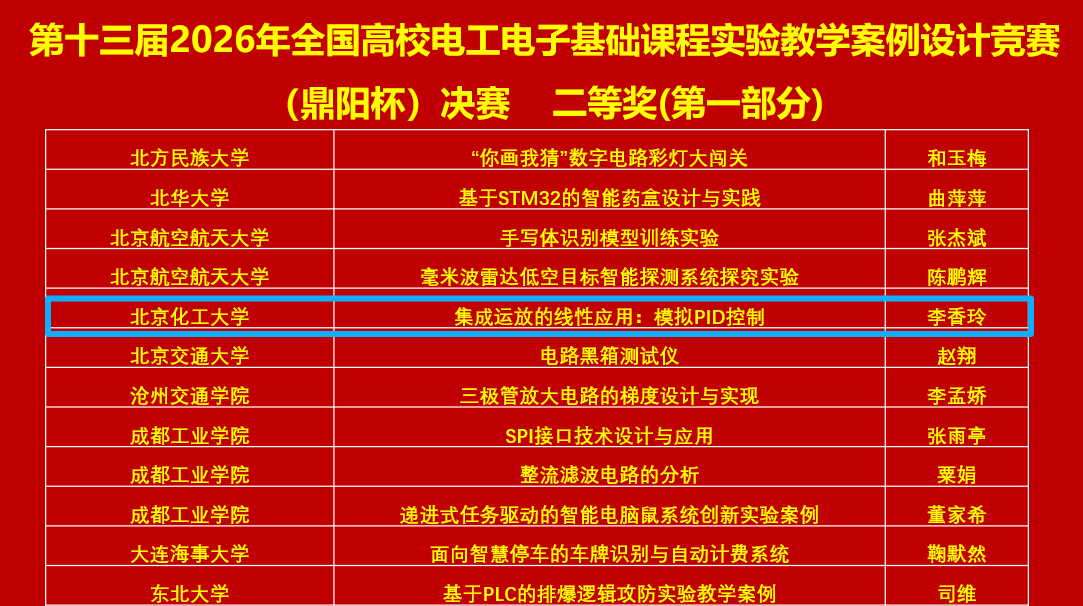
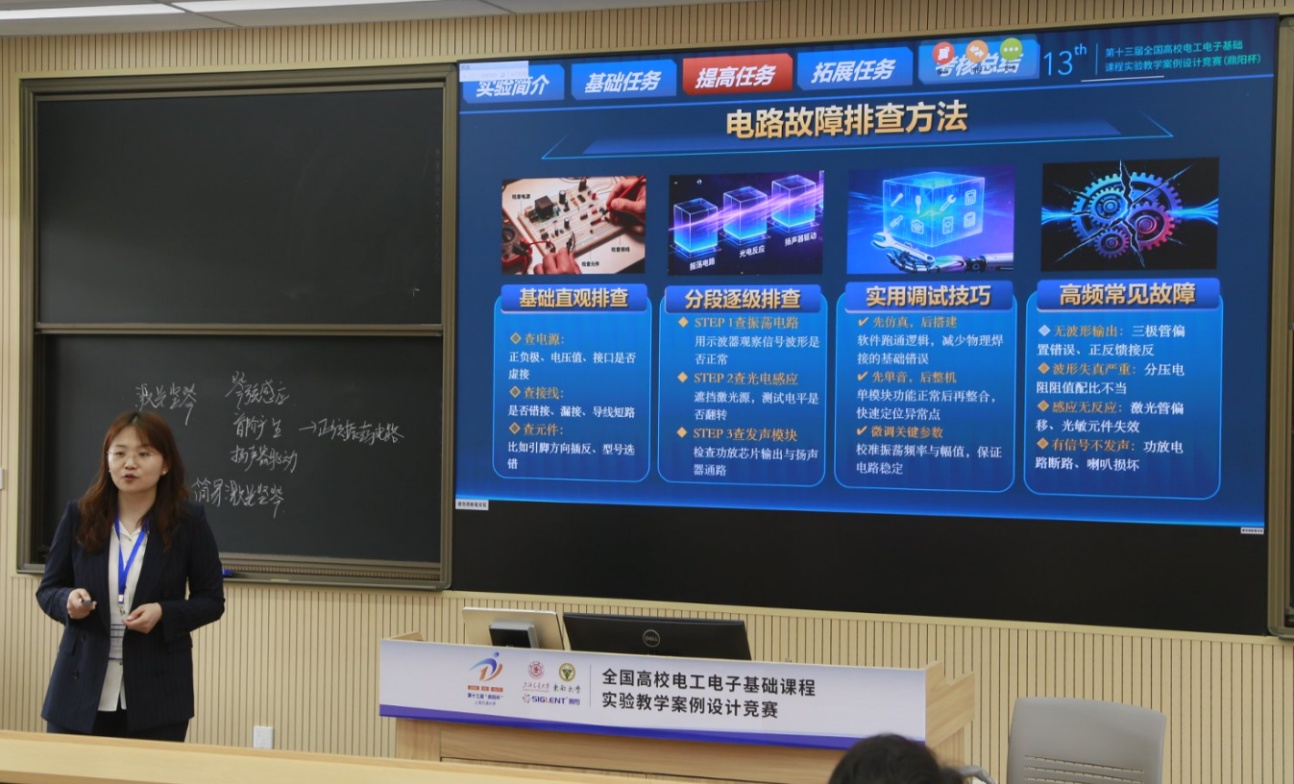
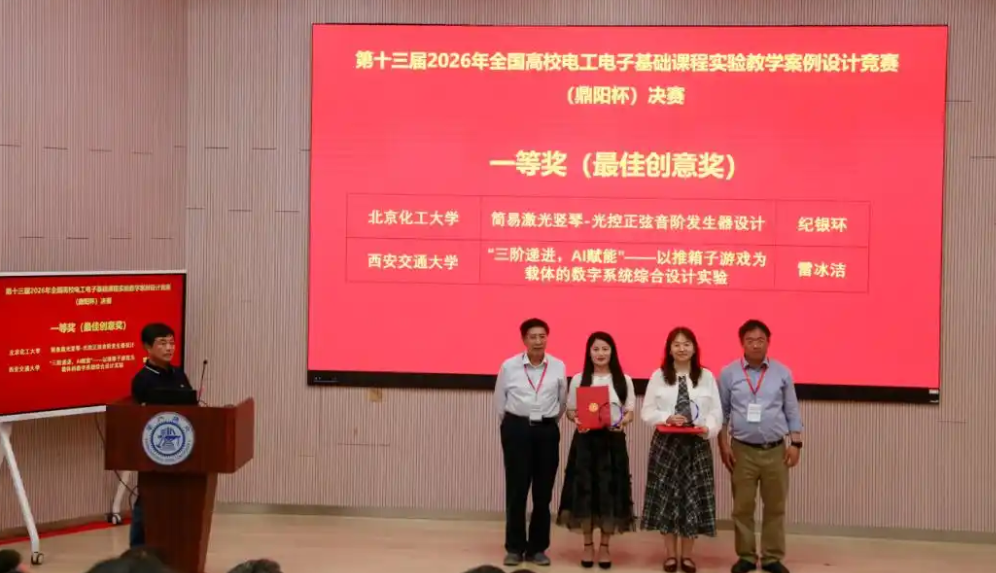
Teacher Ji Yinhuan from the Electrical & Electronic Engineering Center claimed the National First Prize with her entry Design of Simple Laser Harp – Light-Controlled Sine Scale Generator, and stood out to receive the Best Creative Award, being one of only two entries nationwide to earn this honor. This work innovatively integrates laser sensing technology, light control circuit principles, Wien bridge sine oscillation circuits and audio output circuits. It breaks the monotonous, abstract barriers of traditional electrical and electronic experiments, transforming obscure analog electronic oscillation theories and signal generation knowledge into an interesting, visual, interactive and playable physical science and innovation device. Boasting solid theoretical teaching value and immersive practical experience, the design won high recognition from all judges. Meanwhile, another entry submitted by Teacher Li Xiangling, Linear Application of Operational Amplifiers – Analog PID Control, delivered an outstanding performance. Targeting emergency communication scenarios, this design combines analog PID control with pointing adjustment of airbase station antennas, adopts a multi-dimensional hierarchical design framework and closely integrates with specialized courses to break disciplinary boundaries, winning the National Second Prize. The dual awards of First Prize (Best Creative Award) and Second Prize jointly reflect the comprehensive teaching strength and innovation capacity of the faculty team at our university’s Electrical & Electronic Engineering Center.
The awards are the fruitful outcomes of the Electrical & Electronic Engineering Center’s long-term commitment to experimental teaching reform and its adherence to the philosophy of “promoting teaching, advancing reform and integrating competition with teaching through contests”. Centered on the construction of emerging engineering education, the center has long targeted pain points in teaching, promoted integration of electrical and electronic courses with scientific innovation and interdisciplinary knowledge, built a systematic practical teaching framework, and strived to cultivate interdisciplinary engineering talents. Taking this achievement as a new starting point, the center will further deepen teaching reform, refine distinctive teaching features, popularize excellent teaching cases, improve overall teaching quality and teachers’ innovative capabilities, and support the high-quality development of emerging engineering talent training and university education.