
Recently, the research team led by Professor Xiang Deliang from our school has published three consecutive research papers inISPRS Journal of Photogrammetry and Remote Sensing, a top authoritative journal in remote sensing. The research focuses on intelligent interpretation of polarimetric synthetic aperture radar (PolSAR) images, superpixel segmentation, change detection, target dataset generation and other related directions. All three papers list Beijing University of Chemical Technology as the first affiliation, demonstrating the team’s sustained research accumulation and innovative capacity in radar remote sensing information processing and intelligent interpretation.
ISPRS Journal of Photogrammetry and Remote Sensing is an internationally preeminent journal in photogrammetry, remote sensing and spatial information sciences, with an impact factor of 12.2 and a 5-year average impact factor of 13.7. It ranks 1st globally (1/67) among Q1 Journal Citation Reports (JCR) physical geography journals, 2nd globally (2/65) in remote sensing journals, and 4th globally (4/258) in multidisciplinary geoscience journals. The journal has long been categorized as a Zone 1 Top Journal by the Chinese Academy of Sciences Journal Partition Table.
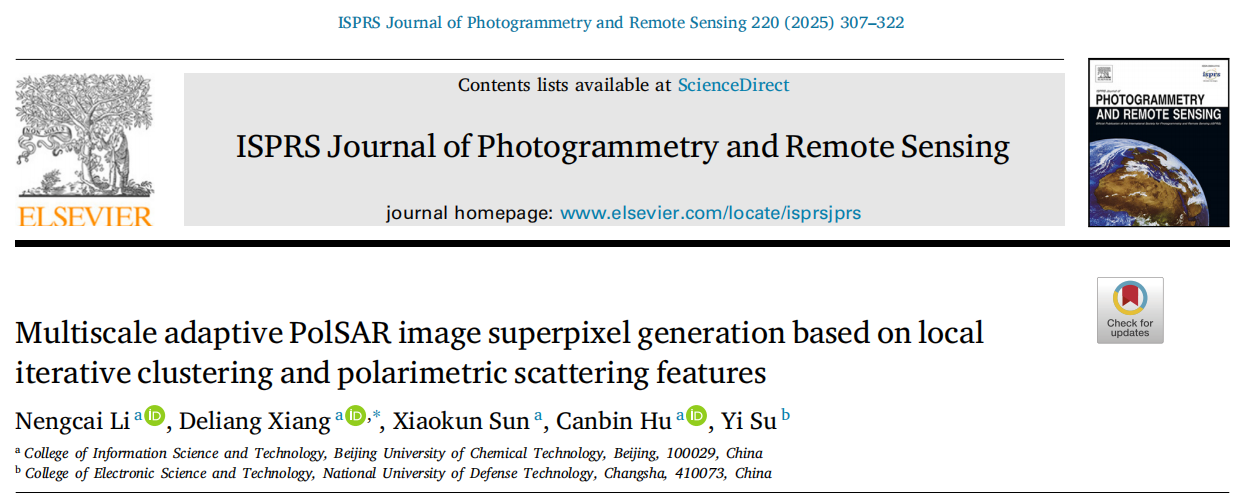
Study 1: Multiscale adaptive PolSAR image superpixel generation based on local iterative clustering and polarimetric scattering features
First Author: Li Nengcai, 2023 PhD candidate, School of Information
Corresponding Author: Professor Xiang Deliang
Aiming at the limitation of existing PolSAR superpixel generation algorithms that fail to simultaneously balance compactness within homogeneous regions and detail preservation in heterogeneous regions, this paper proposes a superpixel generation method integrating polarimetric scattering features and a multi-scale adaptive clustering mechanism. By introducing polarimetric target decomposition features, Riemannian metric and polarimetric homogeneity metric, the proposed method achieves refined segmentation in heterogeneous areas and compact superpixel partitioning for homogeneous regions.
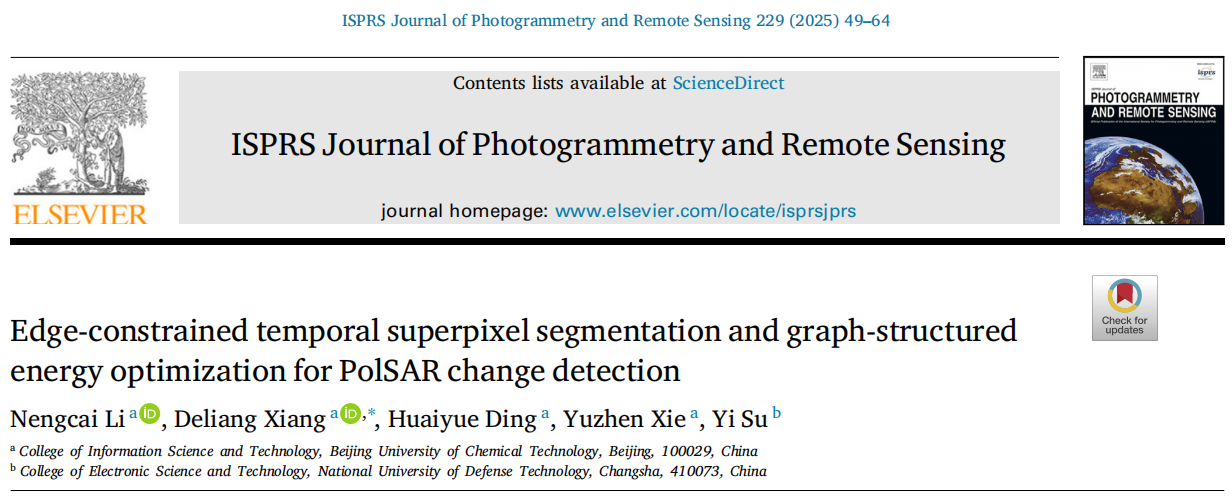
Study 2: Edge-constrained temporal superpixel segmentation and graph-structured energy optimization for PolSAR change detection
First Author: Li Nengcai, 2023 PhD candidate, School of Information
Corresponding Author: Professor Xiang Deliang
To address the challenges of speckle noise interference, multi-temporal radiometric inconsistency and fragmented regional boundaries in PolSAR change detection, this paper develops an edge-constrained temporal superpixel segmentation and graph-structured energy optimization framework for change detection. Taking temporal superpixels as basic processing units, the method jointly models spatial adjacency and temporal polarimetric feature similarity across regions, and infers change states via graph-based energy optimization. This paper has been selected as an ESI Hot Paper (top 0.1% of ESI cited papers), reflecting extensive international attention to this research in the fields of remote sensing and geosciences.
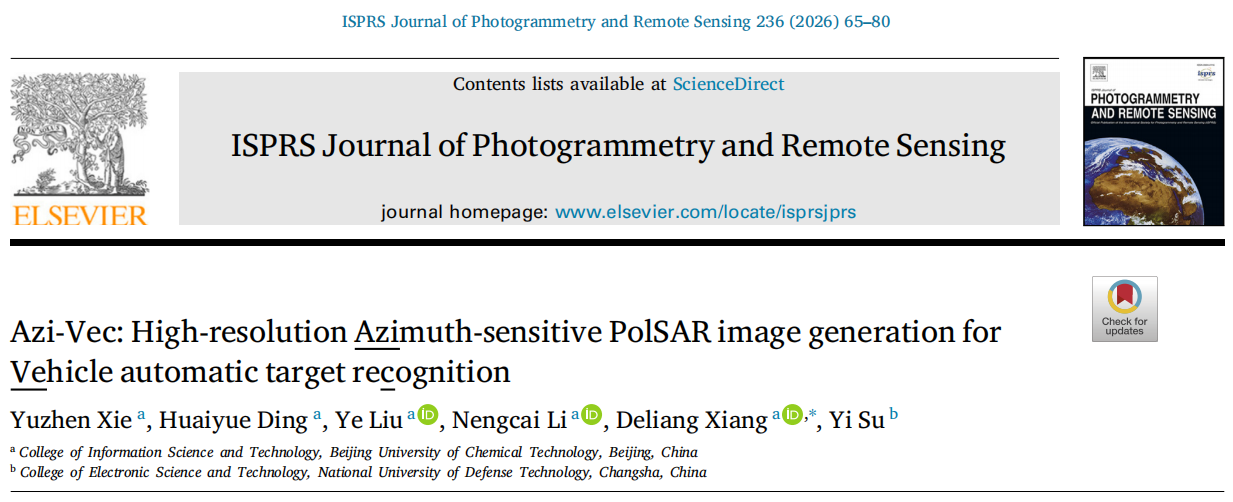
Study 3: Azi-Vec: High-resolution Azimuth-sensitive PolSAR image generation for Vehicle automatic target recognition
First Author: Xie Yuzhen, 2024 PhD candidate, School of Information
Corresponding Author: Professor Xiang Deliang
To tackle the high acquisition cost of high-resolution PolSAR vehicle target datasets, insufficient coverage of observation azimuth angles, and significant variations of target polarimetric responses with azimuth angles, this paper puts forward an azimuth-sensitive high-resolution PolSAR image generation method for automatic vehicle target recognition. By constructing coupling relationships among geometric edges, polarimetric features and imaging parameters, the method physically consistently generates PolSAR vehicle target images under diverse azimuth angles.
The above series of achievements target core scientific challenges in intelligent radar remote sensing interpretation, forming systematic research progress covering polarimetric feature representation, regional structure modeling, multi-temporal change detection and target dataset generation. The consecutive publication of three papers in the ISPRS journal, especially the inclusion of Study 2 as an ESI Hot Paper, marks a major new breakthrough for our school in the interdisciplinary research of radar remote sensing image processing, intelligent earth observation interpretation and remote sensing artificial intelligence.
This series of research was supported by projects including the National Natural Science Foundation of China.