
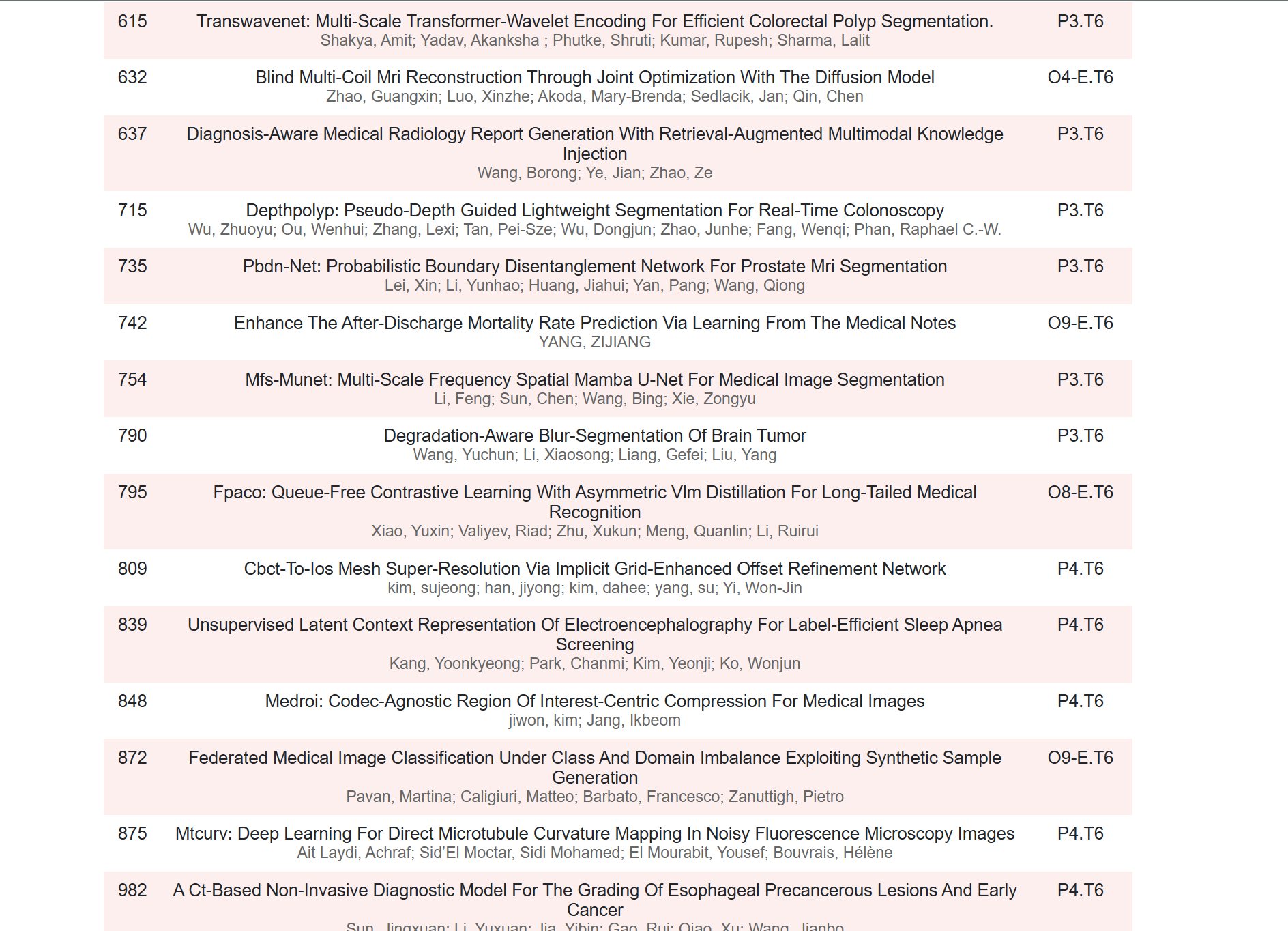
Recently, the paper acceptance results of the 27th International Conference on Pattern Recognition (ICPR 2026) have been officially released. A paper titled FPaCo: Queue-Free Contrastive Learning with Asymmetric VLM Distillation for Long-Tailed Medical Recognition, whose first author is Xiao Yuxin, an undergraduate student majoring in Data Science and Big Data Technology at the College of Information Science and Technology, Beijing University of Chemical Technology (BUCT), has been accepted for oral presentation at the main conference of ICPR 2026.
The paper is jointly completed by faculty and students from the College of Information Science and Technology and the International Education College of BUCT, with BUCT as the primary affiliation, and Associate Professor Li Ruirui serving as the corresponding author.
Hosted by the International Association for Pattern Recognition (IAPR), ICPR is one of the flagship conferences with profound influence in the international pattern recognition community, holding high academic standing alongside core top conferences in computer vision, machine learning, artificial intelligence and related fields. Competition for paper acceptances at ICPR 2026 was fierce. Being selected for an oral presentation fully demonstrates the innovative value and academic recognition of this research in medical artificial intelligence and visual representation learning.
Addressing Challenges of Long-Tailed Learning in Medical Imaging: A Novel Contrastive Learning Framework Integrating VLM Priors
Deep learning technologies have witnessed rapid advancement in medical image analysis in recent years. Nevertheless, restricted by high data acquisition costs and unbalanced disease distribution, medical image datasets generally suffer from long-tailed distribution and severe few-shot learning dilemmas. Such issues cause models to favor high-frequency disease categories while overlooking low-frequency categories with critical clinical significance.
To tackle this challenge, this paper proposes FPaCo, a brand-new framework for long-tailed medical recognition. The method introduces external semantic prior knowledge extracted from Vision-Language Models (VLMs), combined with queue-free contrastive learning strategies, to boost the model’s capability to learn features of tail categories.
Conventional contrastive learning methods built upon feature queues are easily dominated by samples from head categories in long-tailed scenarios, leaving insufficient room for feature learning of tail classes. To mitigate this limitation, FPaCo replaces traditional feature queues with class prototypes to reduce the interference of head categories on the feature space.
Furthermore, VLMs inherently suffer from semantic hallucinations and information omission. To resolve this, the paper designs an asymmetric VLM distillation mechanism. Equipped with an uncertainty gating strategy, this mechanism dynamically adjusts the model’s reliance on external semantic priors, enabling the model to leverage prior knowledge while retaining independent discriminative capacity.
Experimental results verify that FPaCo achieves stable performance improvements on multiple long-tailed medical image classification datasets and effectively alleviates poor recognition performance for tail categories. This research delivers novel solutions for intelligent medical image analysis, weakly supervised visual learning, and the optimization of trustworthy AI models.
Undergraduate as First Author Highlights Young Talents’ Scientific Innovation Potential
This collaborative research is completed by faculty and students from the College of Information Science and Technology, BUCT, with Xiao Yuxin, an undergraduate majoring in Data Science and Big Data Technology, as the first author.
During her undergraduate studies, Xiao Yuxin has conducted research on medical image analysis, fine-grained visual recognition and multimodal intelligence, and participated in multiple AI research projects. For this study, she completed the full research pipeline, including problem analysis, algorithm design, model construction, experimental validation and manuscript writing, centering on the long-tailed learning problem of medical images.
The acceptance of this oral paper at ICPR 2026 marks a vital achievement for BUCT undergraduates engaging in cutting-edge international AI research and winning global academic recognition. It also reflects the fruitful outcomes of the university’s cultivation of high-caliber innovative talents.
Advancing Interdisciplinary Research on Medical AI and Trustworthy Machine Learning
Focusing on core bottlenecks in medical artificial intelligence, this research integrates vision-language models, contrastive learning, uncertainty modeling and long-tailed visual recognition, offering new insights to address real-world challenges including unbalanced data distribution and insufficient model generalization capacity in clinical scenarios.
Moving forward, the research team will continue in-depth studies on multimodal artificial intelligence, medical visual analysis and trustworthy machine learning. The team aims to develop more efficient, reliable and interpretable intelligent models, providing theoretical and methodological support for empowering healthcare and other industries with AI technologies.
Paper Information
Paper Title:
FPaCo: Queue-Free Contrastive Learning with Asymmetric VLM Distillation for Long-Tailed Medical Recognition
Conference:
The 27th International Conference on Pattern Recognition (ICPR 2026)
Presentation Type:
Main Conference Oral Presentation
First Author:
Xiao Yuxin (Beijing University of Chemical Technology)
Corresponding Author:
Associate Professor Li Ruirui
Affiliation:
College of Information Science and Technology, Beijing University of Chemical Technology