
Recently, Dr. Cai Lei, a newly recruited young faculty member from the team led by Professors Geng Zhiqiang and Han Yongming at the School of Information Science and Technology, has achieved significant research progress. As the first author, he has published important research findings in two top tier international journals, Science and Nature Electronics. Focusing on two fundamental computing problems, namely neural dynamical computing and Fourier transform, the two studies address the urgent demand for high real time and high energy efficiency computing platforms in industrial automation, intelligent control and industrial artificial intelligence. They have broken through key bottlenecks in in memory computing architectures, laying new theoretical foundations for next generation industrial intelligent computing, industrial large model inference and real time optimization of complex processes.
Science: The World’s First Millisecond Scale Neural Dynamical System Based on Phase Change Memory
The research team has successfully developed the world’s first millisecond scale neural dynamical system chip based on phase change memristors. It has overcome the long standing international challenge of “controllable in memory computing” for phase change memristors, and compressed the single step computation latency of neural dynamical systems to 2.12 milliseconds for the first time. Integrating the strong representation capability of neural networks and the continuous evolution mechanism of differential equations, neural dynamical systems serve as a vital foundational model for modelling complex physical processes, intelligent control, computational imaging and digital twins of industrial processes. Nevertheless, since the proposal of neural dynamical systems, achieving millisecond scale real time computing while maintaining continuous modelling accuracy has remained a core challenge restricting their engineering applications.
To tackle this challenge, the team proposes a new paradigm of “controllable in memory computing” based on phase change memristors. By precisely regulating the conductance drift characteristics and multi level conductance states of phase change memory, the team constructs for the first time a programmable and controllable in situ in memory computing mechanism. It realizes the collaborative integration of adaptive integral step size search and multi level conductance multiply accumulate computation in neural dynamical solving, forming a complete end to end design spanning devices, algorithms and chip architectures. Compared with conventional digital computing architectures, this scheme substantially reduces computing overhead induced by data movement, cache access and repeated read write operations. While preserving computation accuracy, it markedly improves real time performance and energy efficiency.
Experimental results show that for identical neural dynamical computing tasks, the proposed system achieves a speedup of 3.82 36.27 times and an energy efficiency improvement of 11.75 24.73 times relative to state of the art dedicated application specific integrated circuits (ASICs). For complex dynamical modelling tasks such as cortical surface reconstruction, it delivers a speedup of 50.38 478.18 times compared with the NVIDIA A100 GPU. This achievement marks the advent of millisecond scale real time neural dynamical computing, providing a novel computing platform for brain computer interfaces, brain digital twins, intelligent medicine and other fields. Meanwhile, its capability for real time solving of continuous dynamics is also applicable to industrial automation scenarios including chemical process modelling, industrial digital twins, predictive control and health monitoring of complex equipment. It establishes a brand new hardware foundation for online modelling, real time optimization and autonomous control of complex process industry systems.
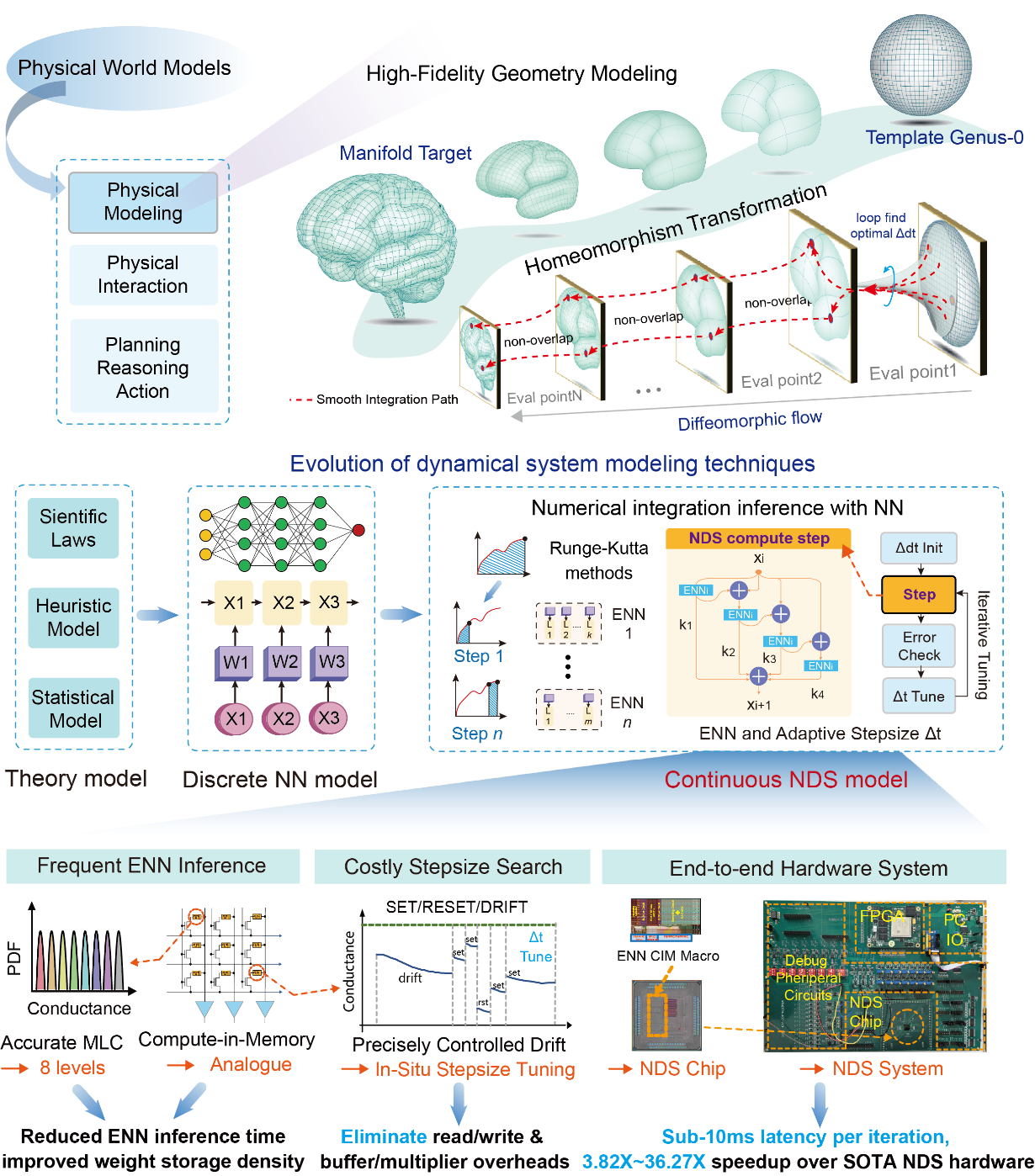
Figure: Millisecond scale neural dynamical system based on phase change memristors (Paper DOI: [https://doi.org/10.1126/science.aee6277](https://doi.org/10.1126/science.aee6277))
Nature Electronics: First Principles Fourier Transform System Based on Heterogeneous Integration of Novel Memories
The research team has realized for the first time a first principles Fourier transform system (Hetero Integrated Fourier Transform, HIFT) built on a heterogeneous memristor integration architecture. A high throughput spectral computing framework combining volatile and non volatile memristors is proposed. For the first time, the computation mechanism of the Fourier transform is re defined from the perspective of material physics. It enables efficient computation of arbitrary base as well as uniform and non uniform discrete Fourier transforms on a unified hardware platform, driving a pivotal shift in Fourier transform hardware systems from traditional algorithm driven operation to material and physical law driven operation.
Innovatively, the system heterogeneously integrates volatile vanadium dioxide (VO₂) memristors with non volatile tantalum oxide/hafnium oxide (TaOₓ/HfOₓ) memristors. Leveraging the complementary strengths of the two categories of devices in frequency generation and in memory computing, the Fourier transform process traditionally implemented by digital logic circuits is transformed into physical computation realized via the natural evolution of material conduction characteristics and phase change oscillations. This achieves deep integration of algorithms, devices, materials and circuits. It delivers a high real time, high energy efficiency and low power consumption computing platform for industrial large model inference, intelligent sensing and complex process control. The findings further advance the co design of hardware and software in industrial automation, and lay an important foundation for the evolution of future industrial intelligent control systems toward autonomous perception, autonomous decision making and autonomous optimization.
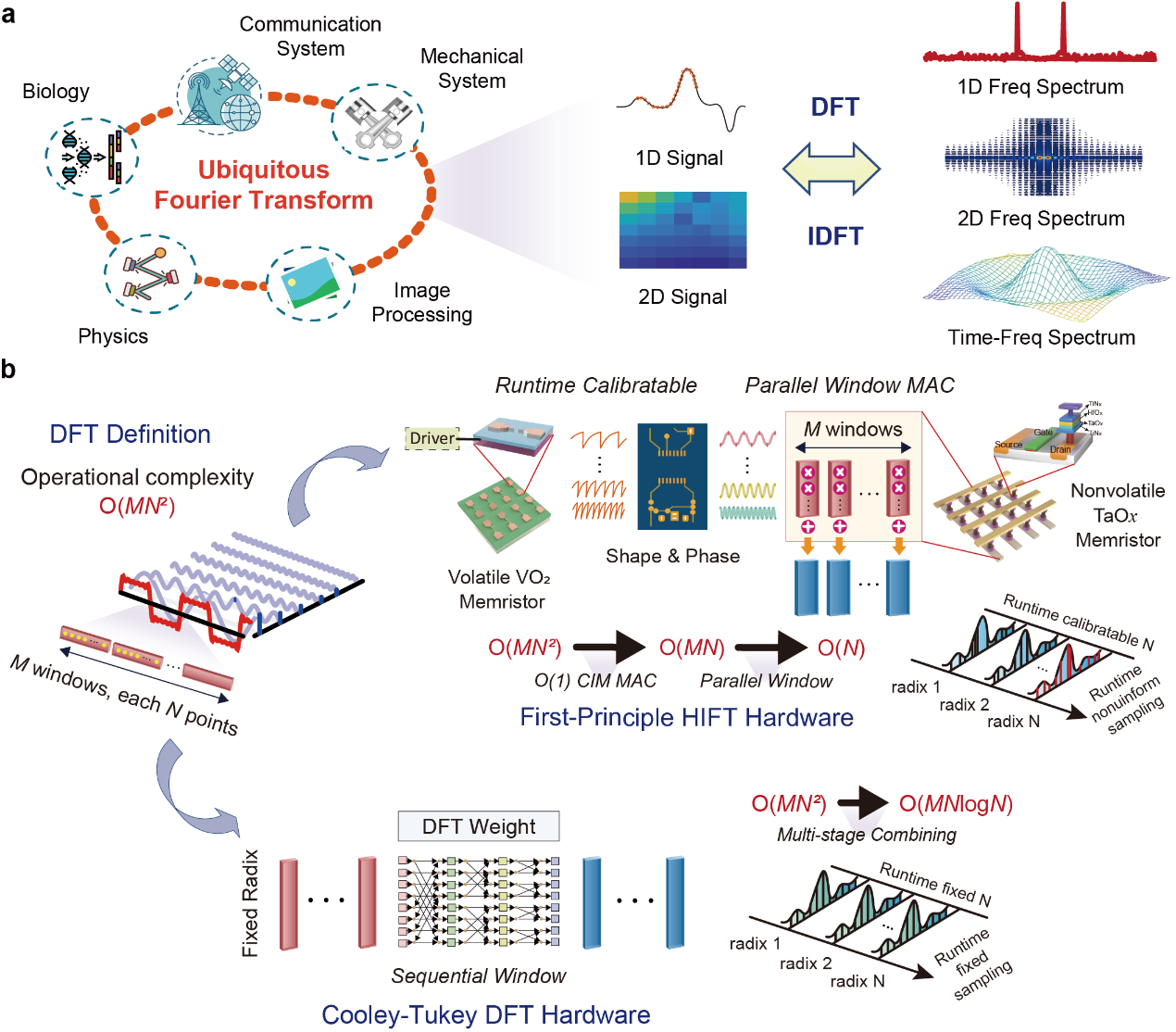
Figure: Schematic diagram of the first principles Fourier transform system based on heterogeneous memristor integration architecture (Paper DOI: [https://doi.org/10.1038/s41928](https://doi.org/10.1038/s41928) 025 01534 8)